


Yooz 2026 AI in Finance Report: Manufacturing Industry Spotlight
AI Confidence Is High in Manufacturing Finance, But Consistency Still Lags, Opening a Competitive Edge
Manufacturing finance professionals report strong confidence in AI’s potential, but adoption remains concentrated in a few areas and half have yet to see clear benefits. The data points to a focused opportunity: expand AI from analytics into core financial workflows, close the training gap, and give teams tools that deliver visible, verifiable results.
AI adoption is gaining traction across finance, with two thirds of teams now using or piloting AI-powered tools. But the pace and depth of adoption vary by industry. In manufacturing, where finance teams manage complex supply chain accounting, multi-facility cost tracking, and high-volume vendor relationships, the picture is distinctive. Confidence is high, interest is strong, and teams are ready for AI to do more.
To understand how manufacturing finance teams compare to the broader landscape, Yooz examined industry-level data from its 2026 AI in Finance Report, which surveyed 500 finance professionals across industries via the third-party survey platform Pollfish in January 2026. The manufacturing findings in this report are based on a subset of respondents from the manufacturing industry and should be read as directional indicators, presented alongside the full survey results for context. With that framing in mind, the data reveals a manufacturing finance workforce that believes in AI’s value and is ready for deeper integration. The next phase of progress will come from expanding beyond analytics into the core transactional workflows where AI can deliver measurable, repeatable results.
Key Findings of the Yooz 2026 AI in Finance Report: Manufacturing Spotlight
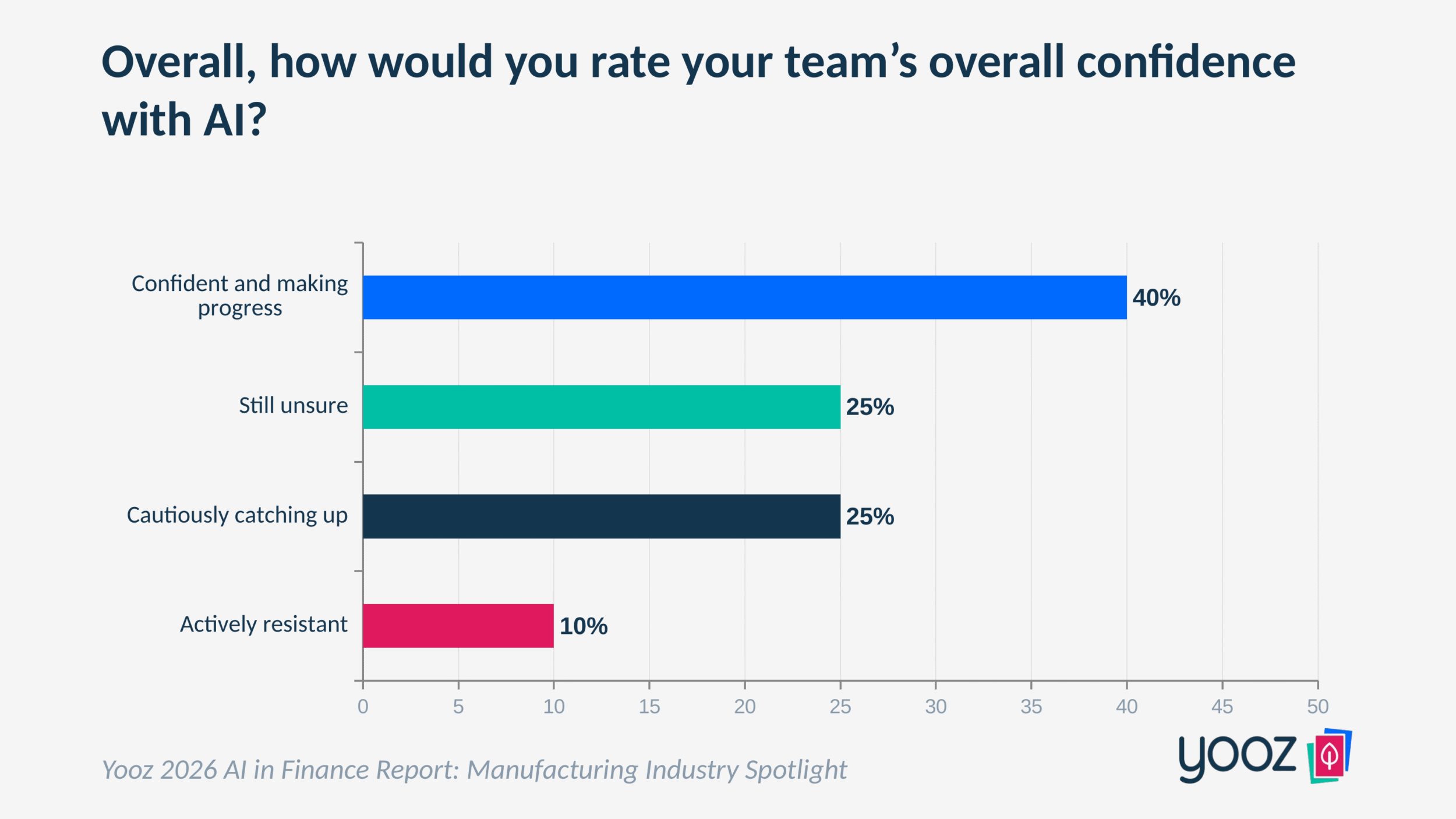
- Manufacturing finance teams rate their AI confidence well above average, setting a strong foundation for deeper adoption. 40% of manufacturing finance professionals describe their team as “confident and making progress” with AI, compared to 27% across all industries. That self-assessed confidence creates a valuable starting point for the next phase of integration.
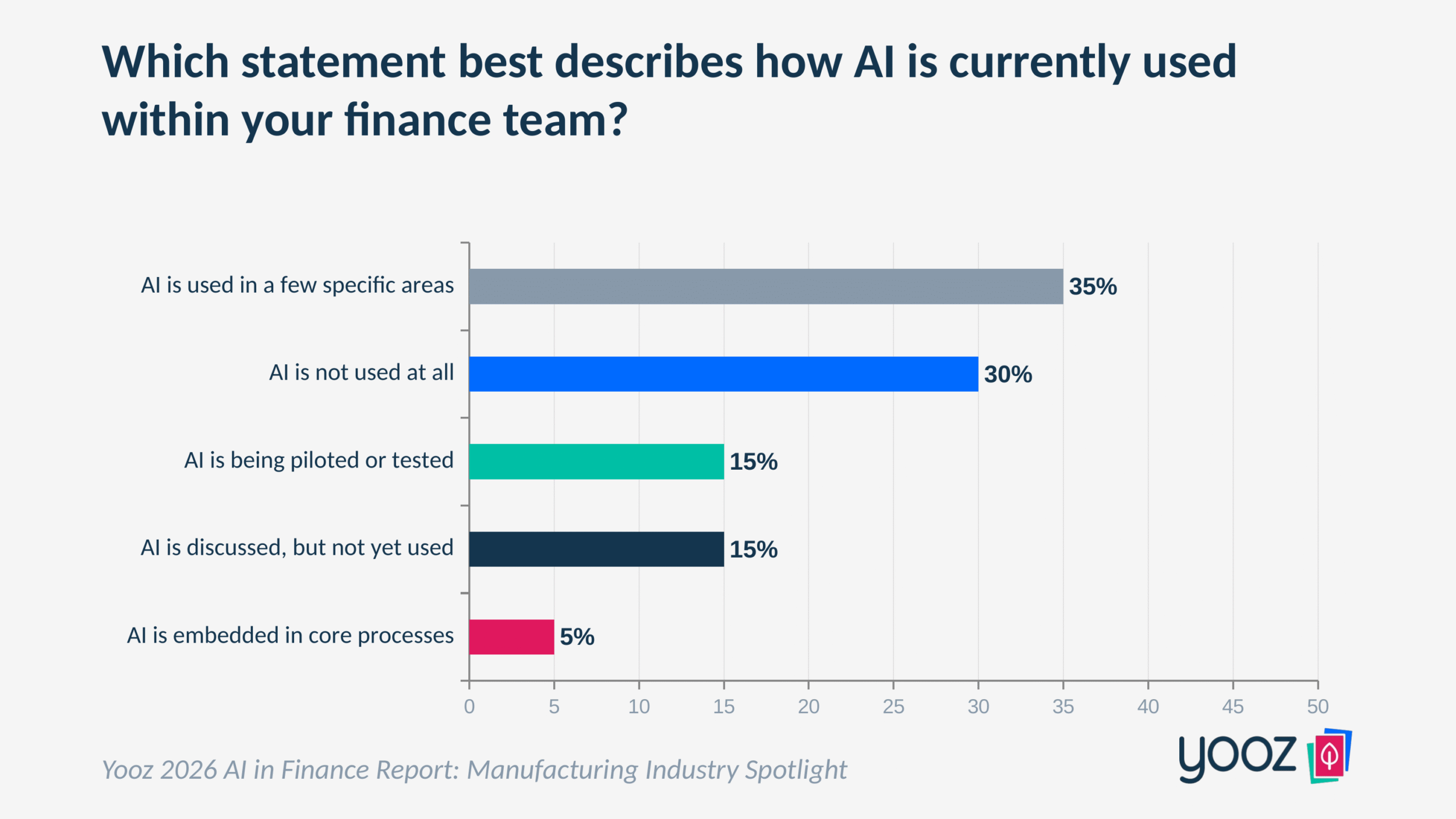
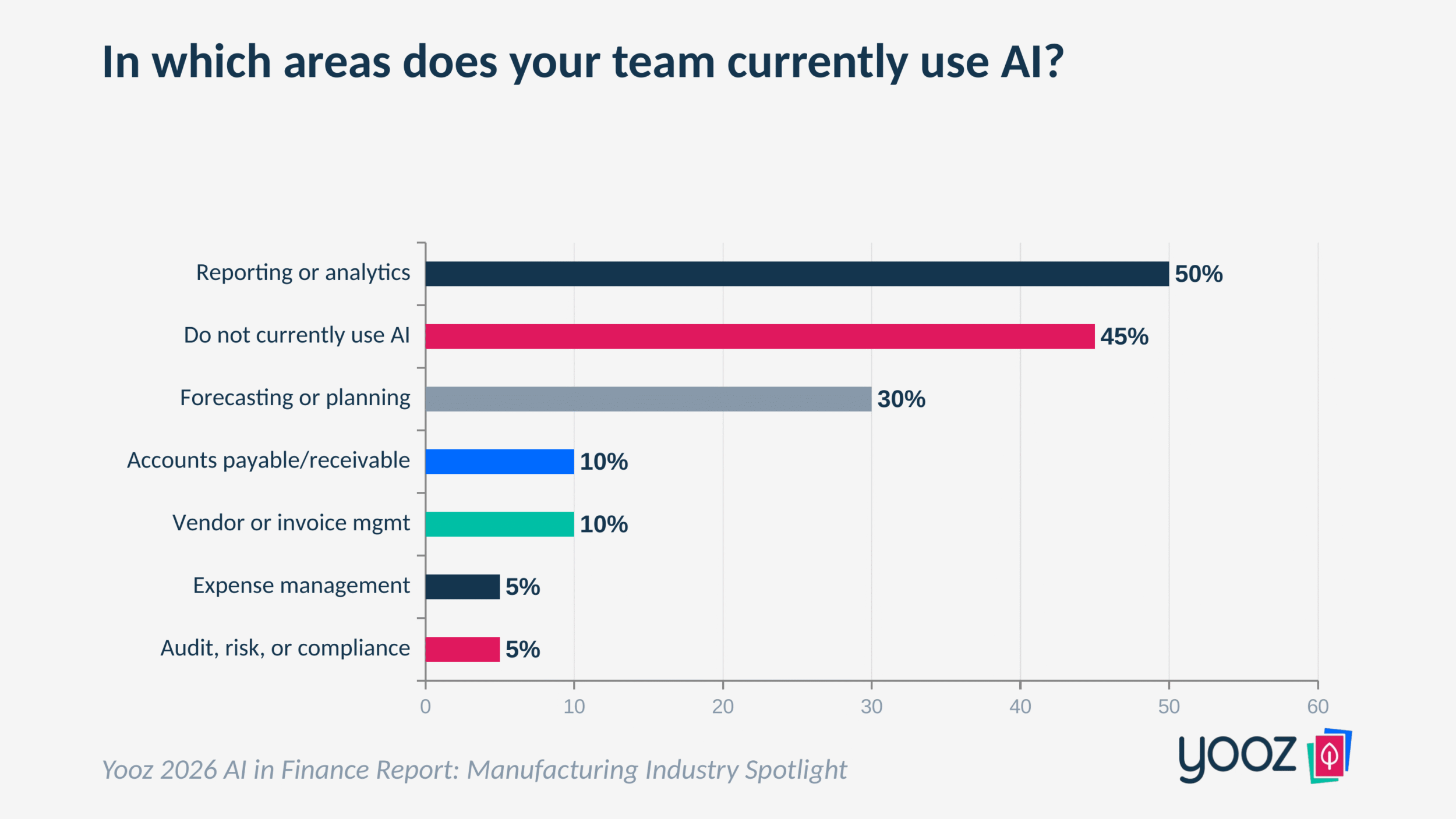
- AI adoption is underway, with the biggest opportunity in expanding beyond analytics. Over half (55%) of manufacturing finance teams say they are using or piloting AI. Usage is concentrated in reporting and analytics (50%) and forecasting (30%), while transactional areas like accounts payable, expense management, and compliance remain largely untapped.
- Training and trust remain the clearest levers for acceleration. 60% of manufacturing finance professionals point to either lack of training (35%) or lack of trust in AI outputs (25%) as the single biggest barrier to AI adoption, compared to 51% across all industries.
- Half of manufacturing teams have not yet seen clear benefits from AI, which points to the value of embedding AI in workflows where results are visible. 50% of manufacturing respondents say they have not yet seen clear benefits from AI, compared to 33% across all industries. This signals a significant opportunity to connect AI tools to processes where impact is immediate and measurable.
- Manufacturing finance professionals see AI as practical and productive, not experimental. When asked to describe how AI feels inside their finance function, manufacturing teams are far more likely to use words like “empowering” (40% vs. 23% overall) and “efficient” (45% vs. 30% overall), while far fewer describe AI as “experimental” (10% vs. 33% overall).
- The urgency to act is clear. 55% of manufacturing finance professionals agree that finance teams that delay AI adoption will struggle to keep up over time (vs. 46% overall), and half expect their team to be more advanced with AI within a year.
- Middle managers are emerging as a key confidence layer in manufacturing. 25% of manufacturing respondents say managers and team leads are the most confident using AI, compared to 17% overall. That middle-management confidence creates a practical bridge between leadership strategy and day-to-day execution.
AI use in manufacturing finance: strong in analytics, with room to expand into core workflows
Across all industries, two thirds of finance teams (66%) say they are using or piloting AI. In manufacturing, that figure is 55%, and the nature of that usage reveals where the next wave of value will come from. Manufacturing teams that use AI describe it primarily in terms of reporting and analytics (50%) and forecasting or financial planning (30%). These are high-value areas, and the fact that manufacturing finance teams are already applying AI to them signals real capability.
At the same time, the data highlights how much room there is to broaden AI’s reach. Usage in accounts payable and receivable (10% vs. 18% overall), expense management (5% vs. 18% overall), and audit, risk, or compliance (5% vs. 19% overall) remains well below average. These transactional, high-volume workflows are precisely where embedded AI delivers the most consistent and measurable returns: automating invoice capture, flagging anomalies, matching vendors, and surfacing exceptions before they become problems.
 The opportunity is to take the momentum manufacturing teams have built in analytics and extend it into the operational workflows that drive day-to-day financial execution. When AI operates inside core processes, results become visible across the organization, not confined to a few reports.
Confidence is a strength. Connecting it to visible results is the next step.
Manufacturing finance teams report notable confidence. 40% rate their team as “confident and making progress” with AI, well above the 27% average across all industries. And 55% say they feel confident using AI tools in their day-to-day work, in line with the broader finance population.
Where the story gets more nuanced is in what that confidence has translated to so far. Half of manufacturing finance respondents say they have not yet seen clear benefits from AI (50% vs. 33% overall). That 17-point gap doesn’t signal a lack of potential. It signals that AI hasn’t yet been applied where its impact is most visible. When teams use AI primarily for analytics and forecasting, the value can be real but diffuse. When AI is embedded in transaction-level workflows, catching duplicate invoices, flagging unusual vendor activity, automating routine data entry, the results are concrete and hard to miss.
This is the bridge between confidence and outcomes. Manufacturing finance teams already believe AI can help. The next step is giving them tools and workflows where they can see it working in the processes they manage every day.
Training and trust: the barriers are solvable, and closing them will accelerate progress
When asked to name the single biggest barrier still slowing AI adoption, manufacturing finance teams point to familiar challenges. Lack of training or education leads at 35%, followed by lack of trust in AI outputs at 25%. Together, these two factors account for 60% of manufacturing respondents, compared to 51% across all industries.
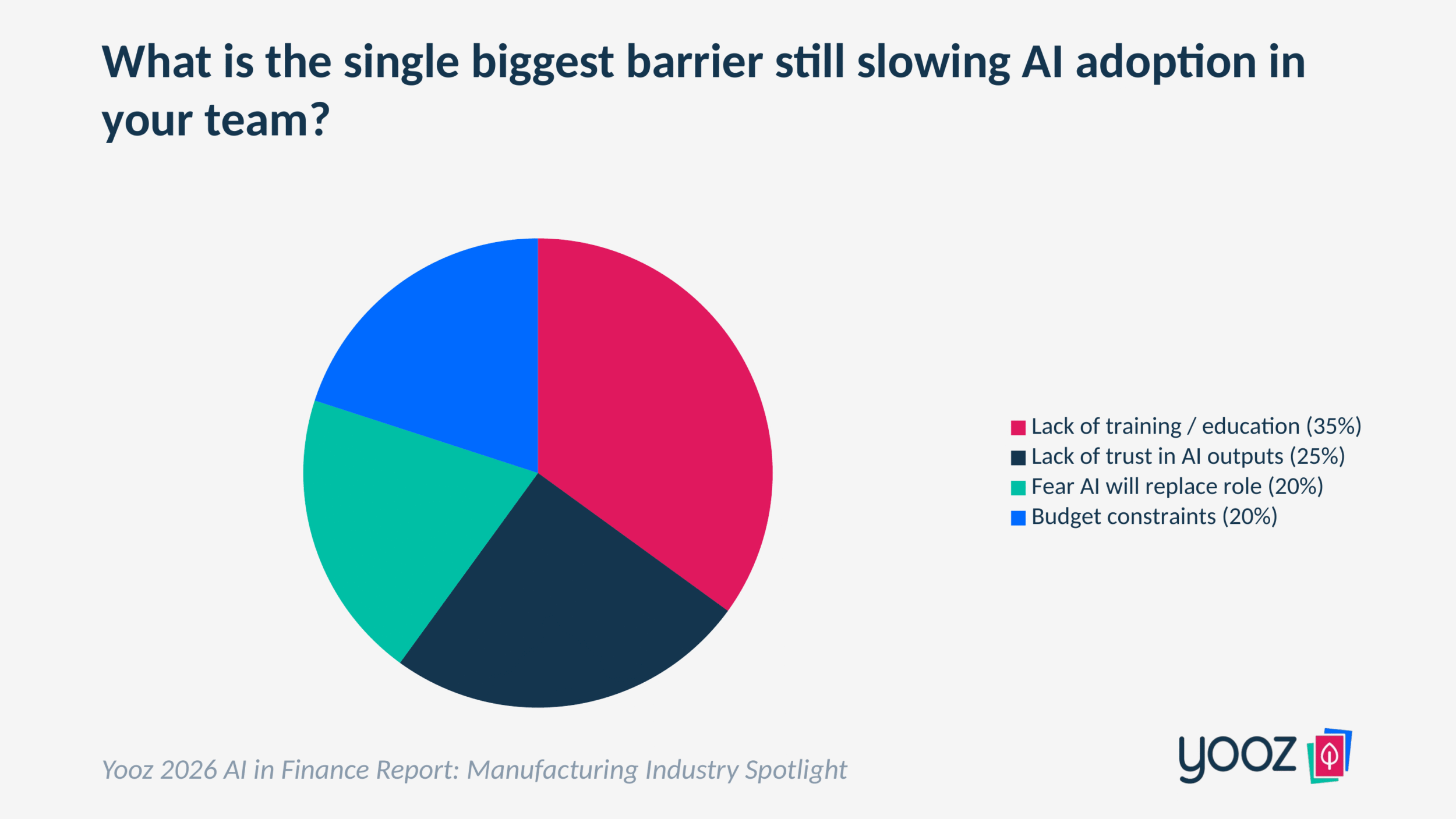 Manufacturing is also more likely than average to cite budget constraints (20% vs. 10% overall), which reflects the reality that many manufacturing finance operations invest heavily in ERP systems and legacy infrastructure, and AI must demonstrate return within that context. But the core message is the same: the biggest barriers are about enablement, not resistance. When teams understand how AI works within their specific workflows and when the tools they use produce results they can verify, adoption moves from scattered experimentation to embedded capability.
Addressing training and trust together creates a reinforcing cycle. Practical, workflow-specific education helps teams understand what AI can and can’t do. Tools that produce transparent, verifiable outputs build trust through direct experience rather than abstract promises. When those two elements come together, the gap between confidence and clear benefits closes.
Middle managers are an underused advantage in manufacturing
Across all industries, IT or technology teams are most often named as the primary driver of AI adoption (24%), followed by executive leadership and C-suite roles. But when it comes to who actually seems most confident using AI day to day, manufacturing shows a distinctive pattern. Managers and team leads are identified as the most confident group at 25%, compared to 17% across all industries.
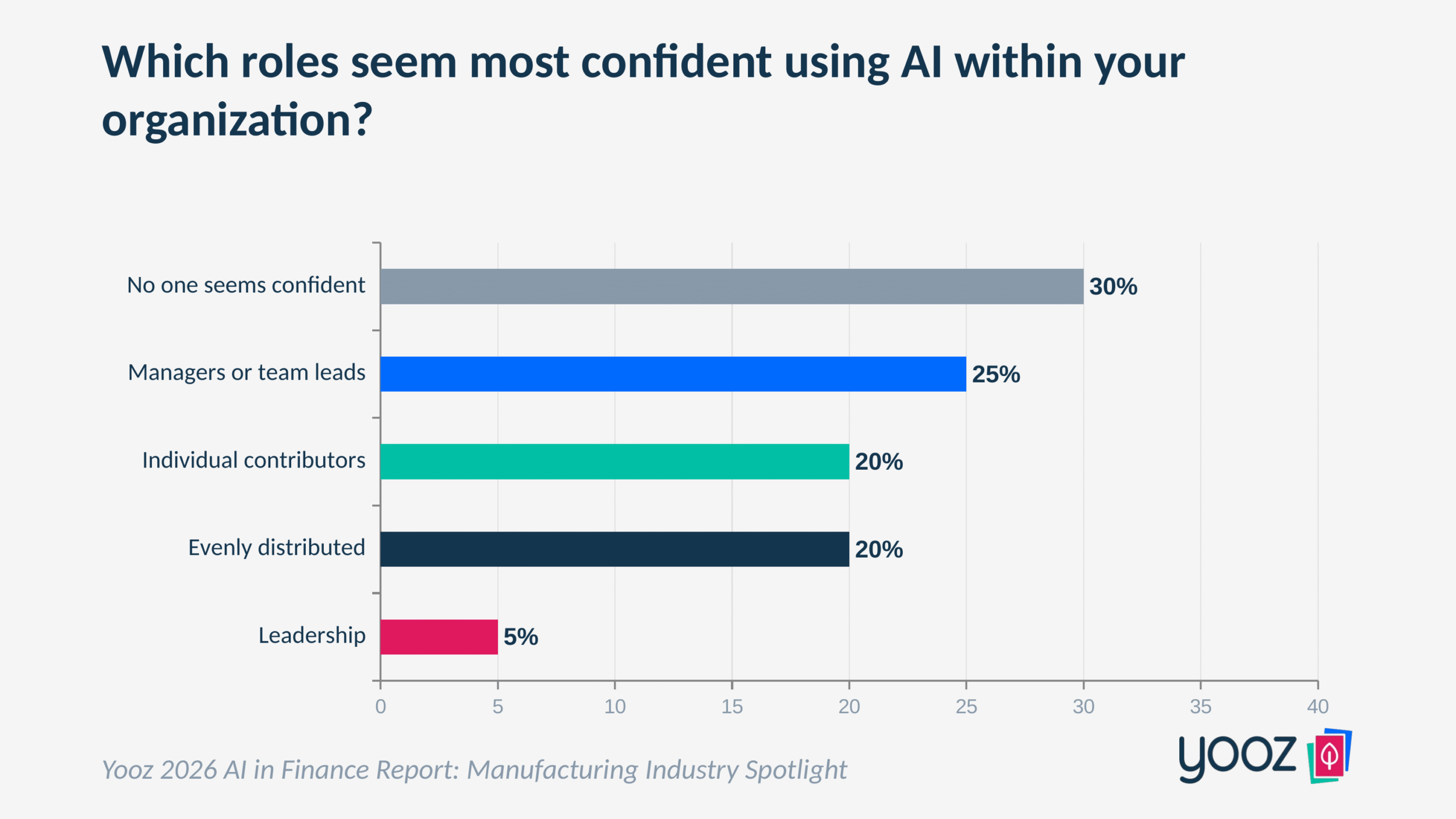 That middle-management confidence is a practical asset. These are the people who understand both the strategic direction from leadership and the operational realities of how finance work actually gets done. They are well positioned to champion AI within their teams, identify the right use cases, and translate training into practice.
At the same time, leadership confidence stands at just 5% in manufacturing, compared to 15% across all industries, and 30% of manufacturing respondents say no one in particular is driving AI adoption at their organization. As finance leadership becomes more visibly accountable for AI-enabled workflows, the middle-management enthusiasm already in place can be channeled into coordinated, organization-wide progress.
Manufacturing teams sense the urgency and see the opportunity ahead
More than half of manufacturing finance professionals (55%) agree that finance teams that delay AI adoption will struggle to keep up over time, above the 46% average. And when asked where they expect their team to be in a year, half expect to be more advanced with AI.
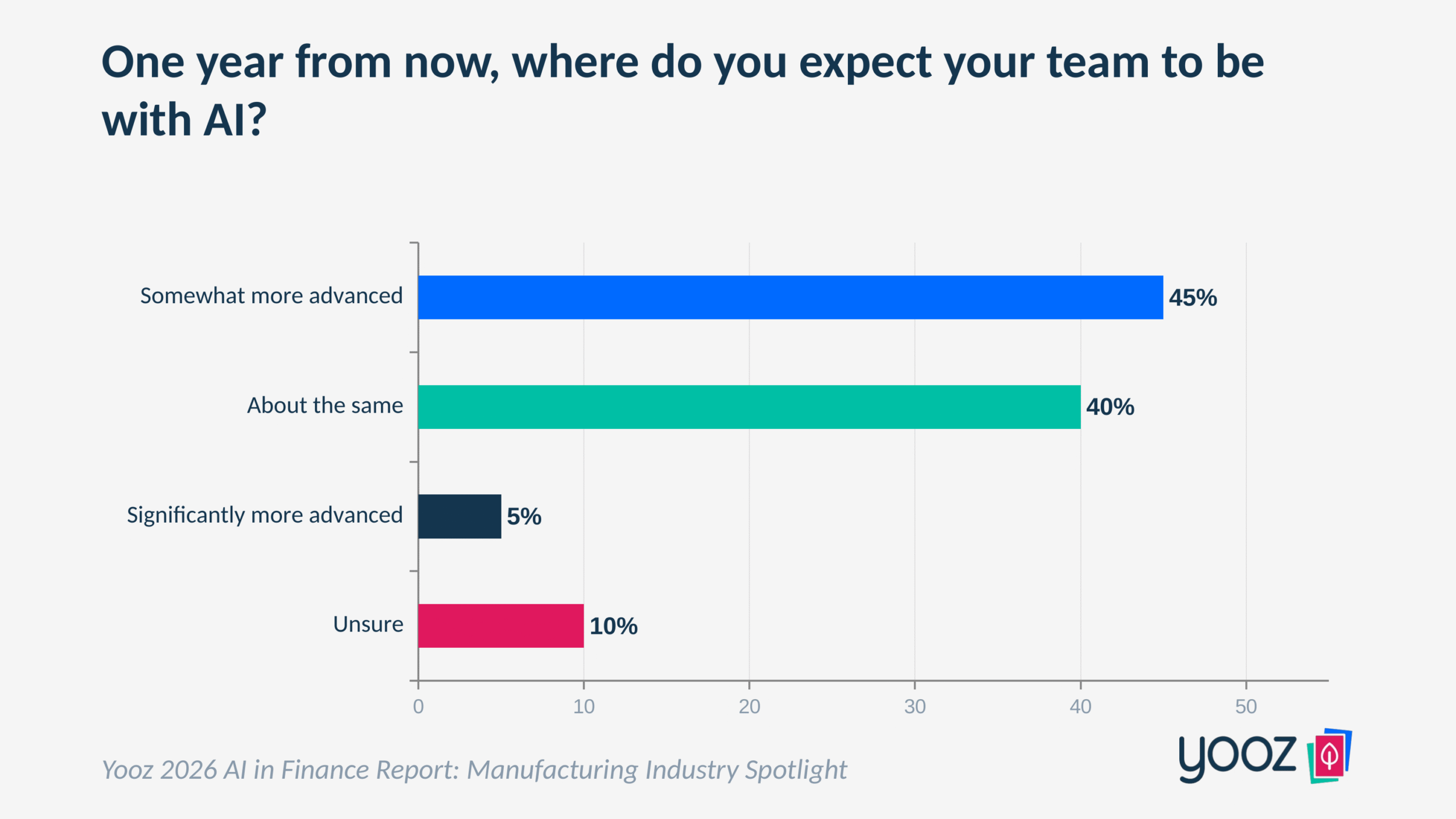 That combination of urgency and forward-looking optimism is a signal that manufacturing finance teams are ready for the next phase. They recognize AI’s strategic importance, they see the gap between where they are and where they want to be, and they are looking for the right path forward. The teams that invest in training, trust-building, and workflow-level integration now will be best positioned to lead.
How manufacturing finance teams can accelerate from here
The data points to a clear and encouraging opportunity for manufacturing finance teams. Confidence is above average. Interest is real. And the barriers teams face, training gaps, output trust, and budget justification, are solvable when AI is embedded directly into the workflows that drive measurable results.
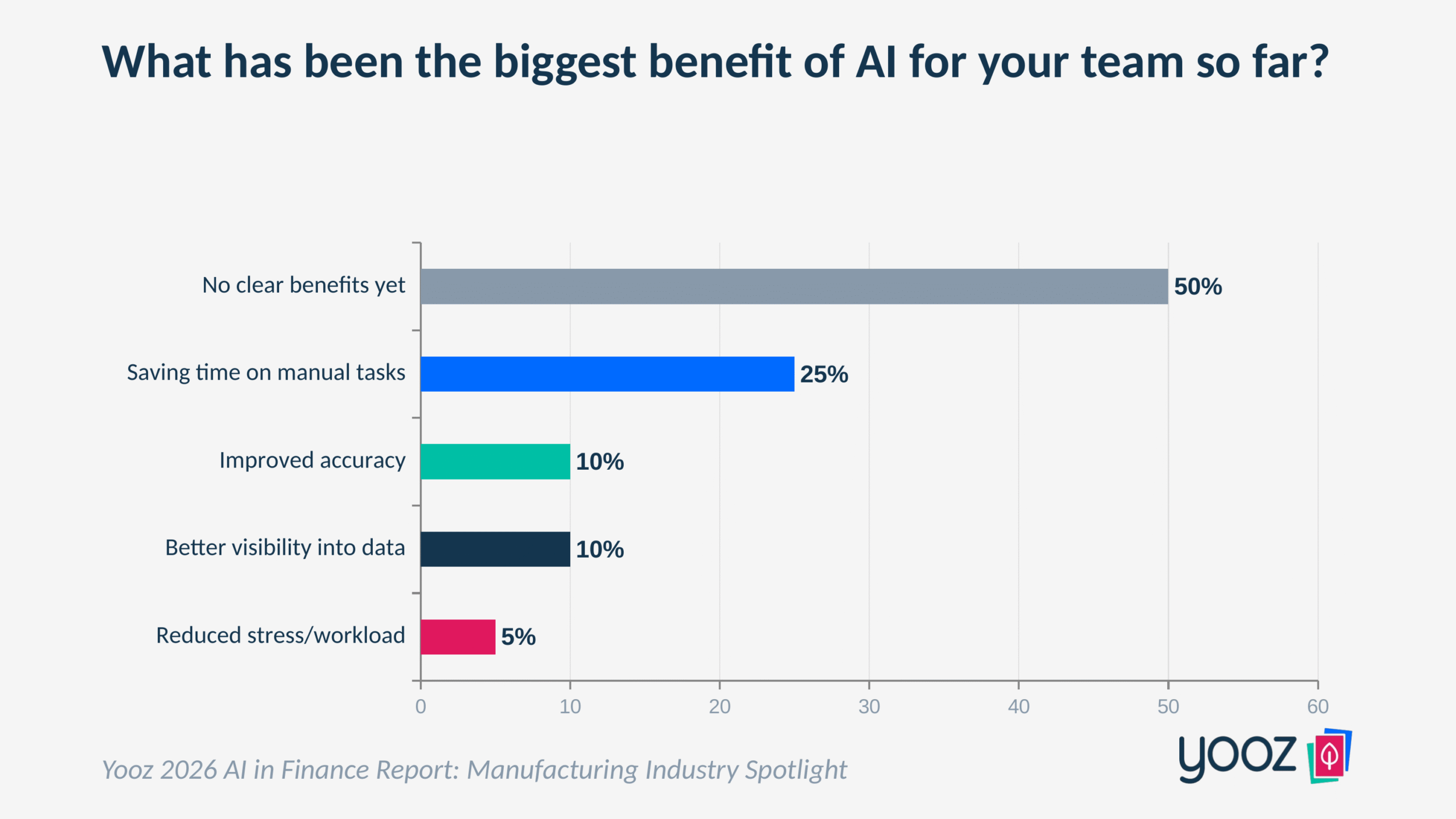
In manufacturing finance, where teams manage complex multi-facility cost allocations, high-volume vendor payments, and intricate supply chain accounting, the entry points for AI are well defined. Automated invoice capture, three-way matching, anomaly detection, and vendor risk scoring can all operate within existing AP and procurement workflows. When AI is applied to tasks like these, where results are verifiable and the impact is measurable, teams build trust through direct experience rather than training alone.
The shift from confidence to consistent results doesn’t require manufacturing finance teams to become AI experts. It requires tools that work reliably inside their existing processes, paired with practical education that shows what AI can and can’t do. When teams see AI catch a duplicate invoice, flag an unusual vendor pattern, or surface an exception before it reaches the approval queue, they don’t need to be convinced of the technology. They see it working. The next step is a focused one: start with the highest-volume, most-repetitive workflows, embed AI there, and let results build the case for expansion.
“For manufacturing finance teams, the real test of AI is whether it improves execution,” said Yooz CEO Laurent Charpentier. “Lean Financial Operations take shape when teams remove avoidable manual work, build more consistent processes, and apply automation where the value is clear and repeatable. The organizations that move first will be the ones that turn strong AI confidence into stronger performance, better control, and lasting operational advantage.”
The Yooz 2026 AI in Finance Report surveyed 500 finance professionals via the third-party survey platform Pollfish in January 2026. Respondents provided insights on their self-reported perceptions of AI usage and readiness, including adoption stage, use cases, perceived benefits, and barriers. Manufacturing industry findings are directional and presented in comparison to the full survey population for context.
Contacts
Media Contact
Idea Grove