


AI Adoption is Rising Among Construction Finance Teams. Now They Need the Right On-Ramp to Real Value.
Construction finance professionals are leaning into AI with growing confidence, and the data points to a clear next phase: embedding AI into core workflows through better training and trustworthy tools. Here’s what the data reveals about where construction stands and where the opportunity is.
AI adoption is gaining traction across finance, with two thirds of teams now using or piloting AI-powered tools. But that momentum isn’t evenly distributed. When you look at construction, an industry where finance teams manage complex project-based accounting, multi-entity payables, and high-volume vendor relationships, the picture shifts. AI interest is high, and the opportunity for deeper integration is significant.
To understand how construction finance teams compare to the broader landscape, Yooz examined industry-level data from its 2026 AI in Finance Report. The construction findings in this report are based on a subset of respondents from the construction industry and should be read as directional indicators, presented alongside the full survey results for context. With that framing in mind, the data suggests construction finance teams are moving in the right direction on AI, with growing confidence and strong forward-looking momentum. The next phase of progress will come from closing the gap on training and trust.
Key Findings of the Yooz 2026 AI in Finance Report: Construction Spotlight
- AI adoption in construction finance is underway, with significant room to expand. Over half (53%) of construction finance teams say they are using or piloting AI. As adoption matures, the next opportunity is embedding AI into core processes, where it can drive repeatable, measurable results across workflows like accounts payable and project accounting.
- Training and trust are the clearest levers for acceleration. More than three out of four construction finance professionals (76%) point to either lack of training (41%) or lack of trust in AI outputs (35%) as the single biggest barrier to adoption. Budget constraints (6%) and regulatory concerns (6%) remain marginal factorsr, which means the path forward is about enablement, not access.
- Construction finance teams see a major opportunity to deepen AI’s role in daily workflows. 65% of construction respondents say AI has not yet become critical to day-to-day operations, compared to 45% across all industries. This signals significant untapped potential as teams move from early experimentation to embedded, workflow-level AI.
- Confidence is trending upward, and the next growth phase is connecting that confidence to real outcomes. 59% of construction finance professionals say they feel more confident with AI than a year ago. At the same time, many have not yet seen AI deliver consistent, practical value in their workflows, pointing to an opportunity to match growing confidence with deeper integration.
- Individual contributors are leading the way on AI confidence in construction. 47% of construction respondents say individual contributors are the most confident with AI, nearly double the 24% rate across all finance teams. That ground-level momentum creates a strong foundation for broader organizational adoption.
- Construction teams are motivated to close the gap. 47% of construction finance professionals agree that peers are further ahead with AI (vs. 33% overall), while 59% expect their team to be more advanced within a year (vs. 46% overall). The awareness and ambition are there.
- The urgency to act is clear. 53% agree that finance teams that delay AI adoption will struggle to keep up over time. When asked what has made the biggest difference in improving AI adoption, 53% of construction respondents say adoption hasn’t really worked yet, compared to 32% across all industries. The window for early movers to gain a competitive advantage is wide open.
AI use in construction finance: momentum with room to grow across fragmented teams
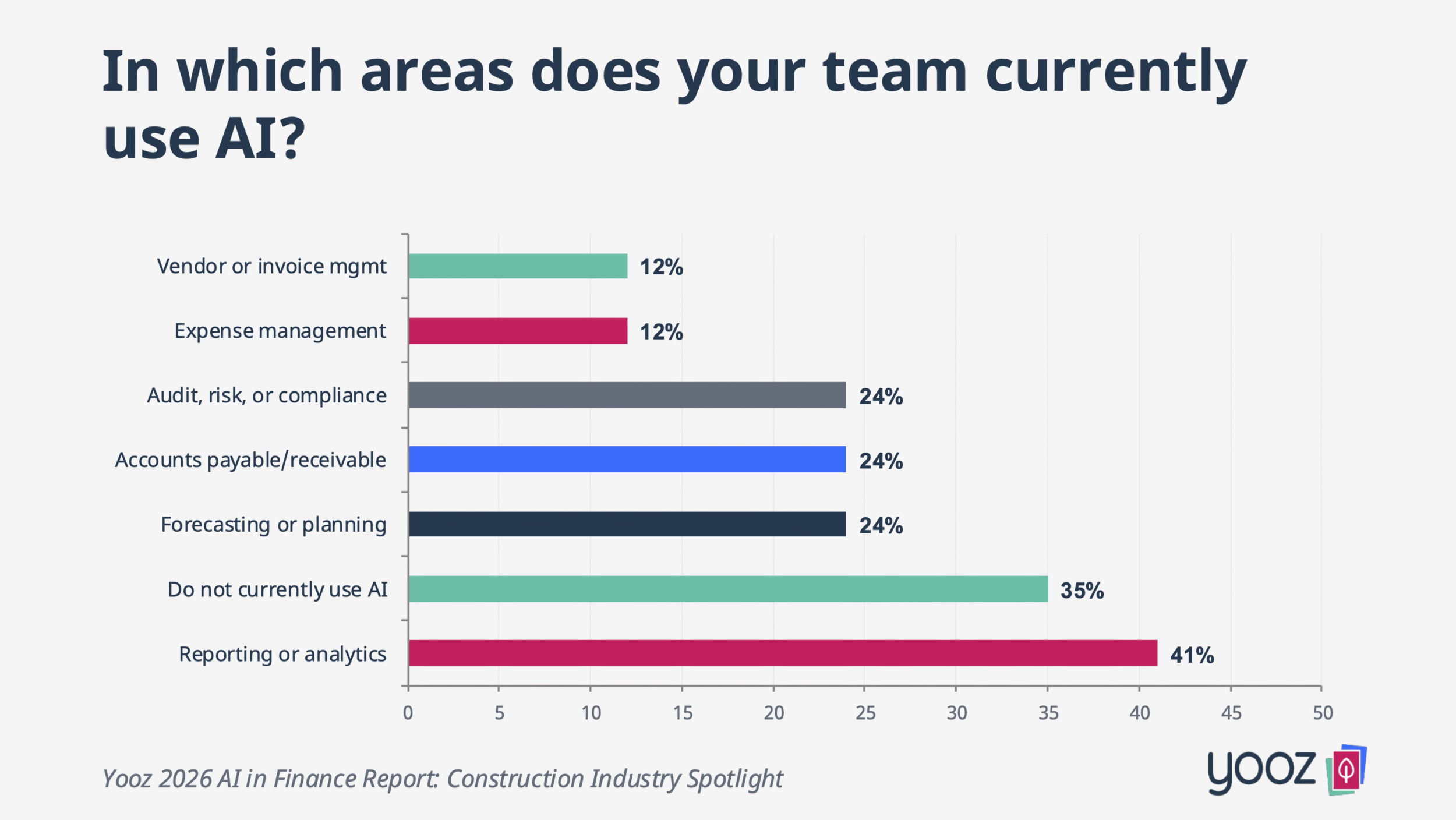
Across all industries, two thirds of finance teams (66%) say they are using or piloting AI. In construction, that figure is 53%, and the nature of that usage points to where the next wave of progress will come from. Most construction teams that use AI describe it as confined to a few specific areas (41%) or still being piloted (12%). As these early efforts mature, the opportunity is to expand AI into core processes where it can deliver consistent, scalable value.
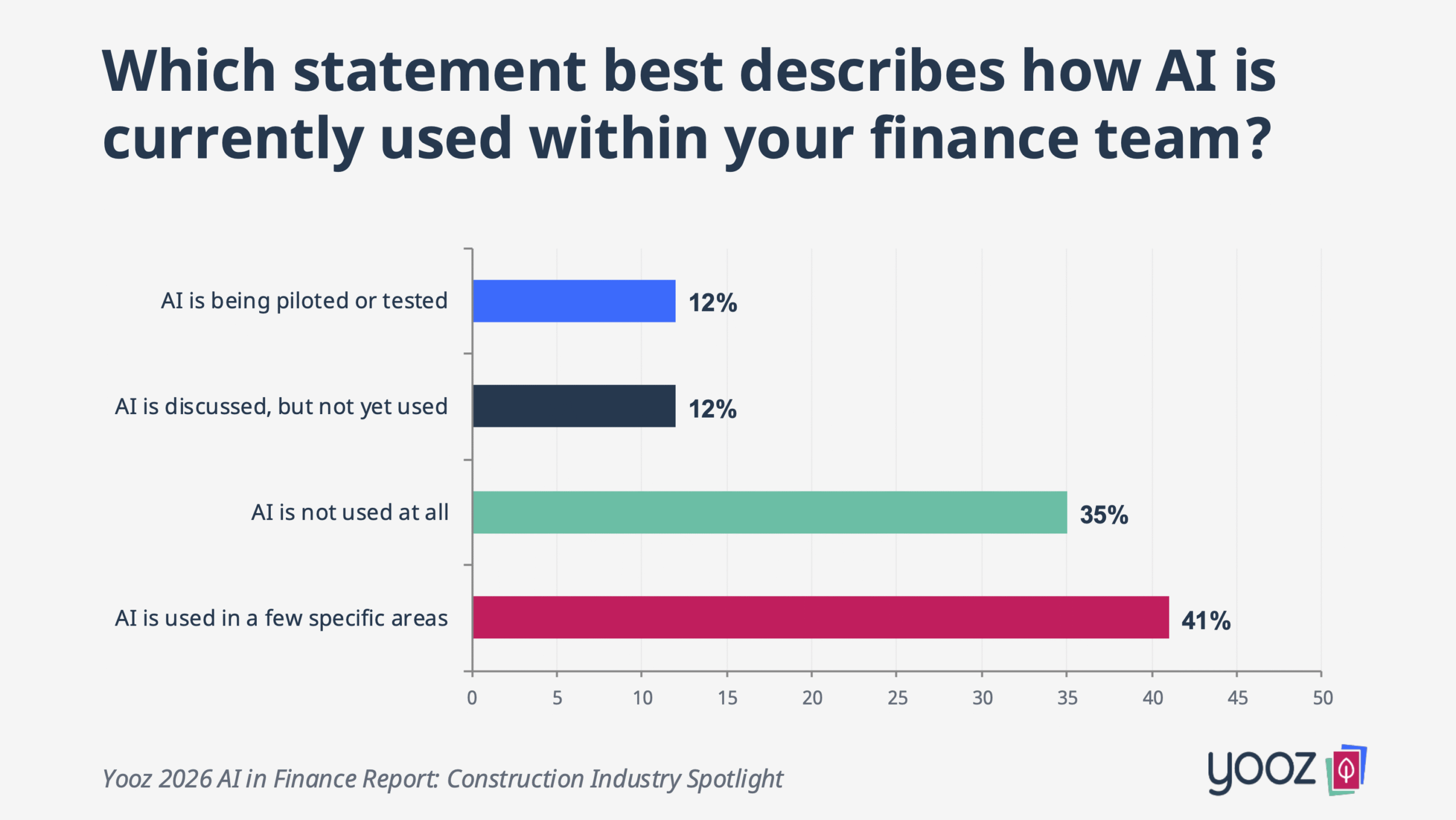
At the same time, 35% of construction finance teams say AI is not used at all, compared to 22% overall. That gap represents a meaningful opportunity: construction finance teams that begin embedding AI into high-volume workflows like invoice processing, vendor management, and project-based accounting can move ahead of peers who are still on the sidelines.
The data also highlights how much room there is to deepen AI’s integration. When asked what would happen if AI tools suddenly disappeared, 65% of construction respondents say their workload would barely change, compared to 45% across all industries. That signals AI is still in the early stages of integration for most construction finance teams, which means the biggest gains from embedding AI into repeatable workflows are still ahead.
Confidence is growing, and the next step is connecting it to results
Construction finance professionals are leaning in. In fact, 59% say they feel more confident using AI than they did a year ago, slightly above the 53% average across all industries. And when asked whether they feel confident using AI tools in their day-to-day work, 59% agree, broadly in line with the overall population (51%).
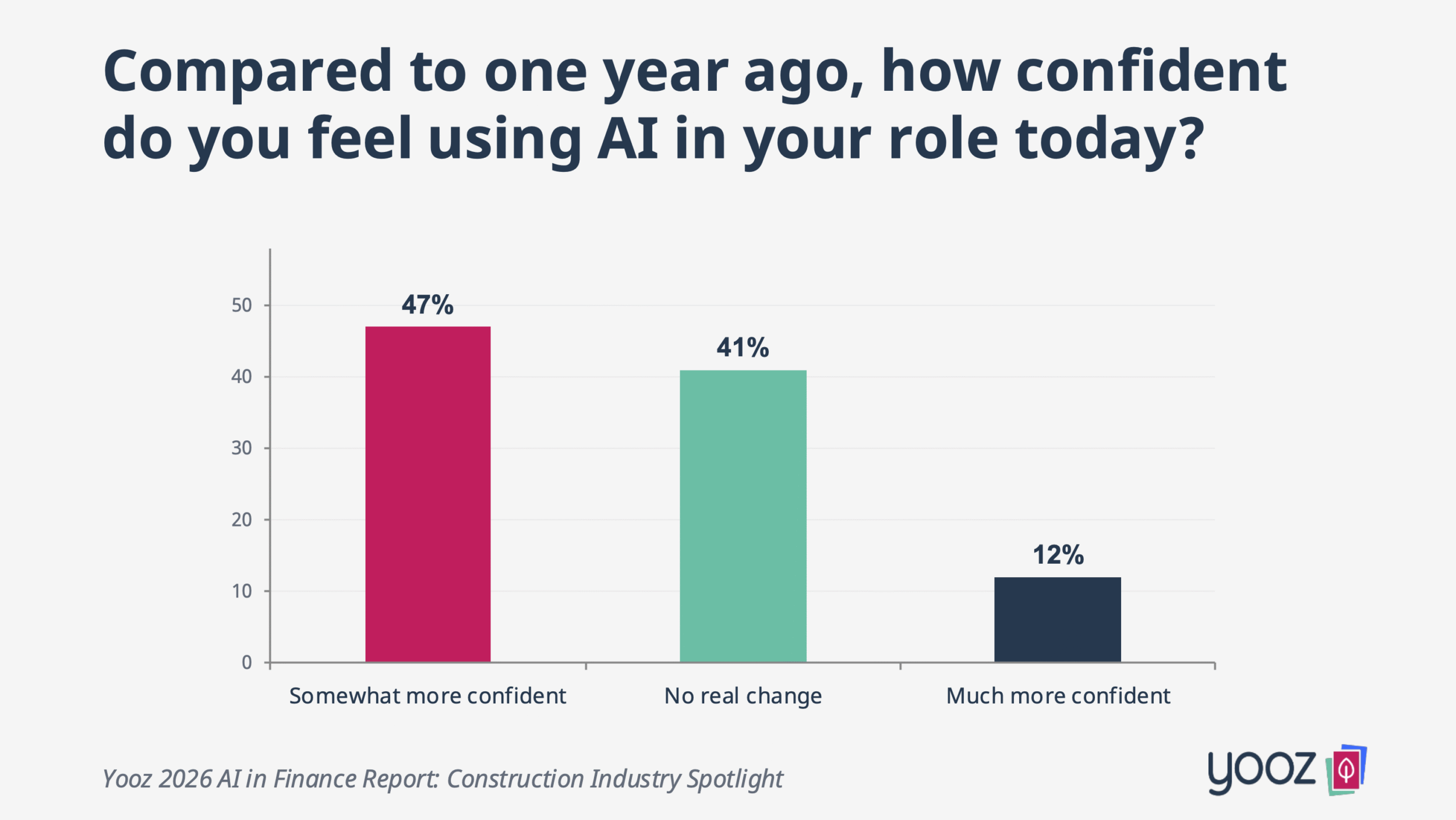
Where construction diverges is in the connection between confidence and visible outcomes. More than half of construction respondents (53%) have not yet seen AI move beyond early-stage experimentation to deliver consistent, practical value, compared to 33% overall. That 20-point gap suggests construction finance teams are ready for AI to do more. They are building familiarity and comfort, and the next phase is giving them tools and workflows where they can see AI working inside the processes they already manage.
That gap between growing personal confidence and organizational results points to a clear next step: embedding AI into workflows where value is visible and verifiable. When finance teams experience AI catching errors, surfacing anomalies, or automating routine data capture in their actual day-to-day work, confidence compounds and adoption accelerates. This is where workflow-embedded AI solutions make the difference. AI must operate within financial processes, not alongside them, so outputs can be verified, trusted, and tied directly to operational results.
Training and trust: the two levers that will unlock the next phase
When asked to name the single biggest barrier still slowing AI adoption, construction finance teams are clear. Lack of training or education is the top answer (41%), followed by lack of trust in AI outputs (35%). Together, these two factors account for more than three out of four construction respondents (76%), compared to 51% across all industries.
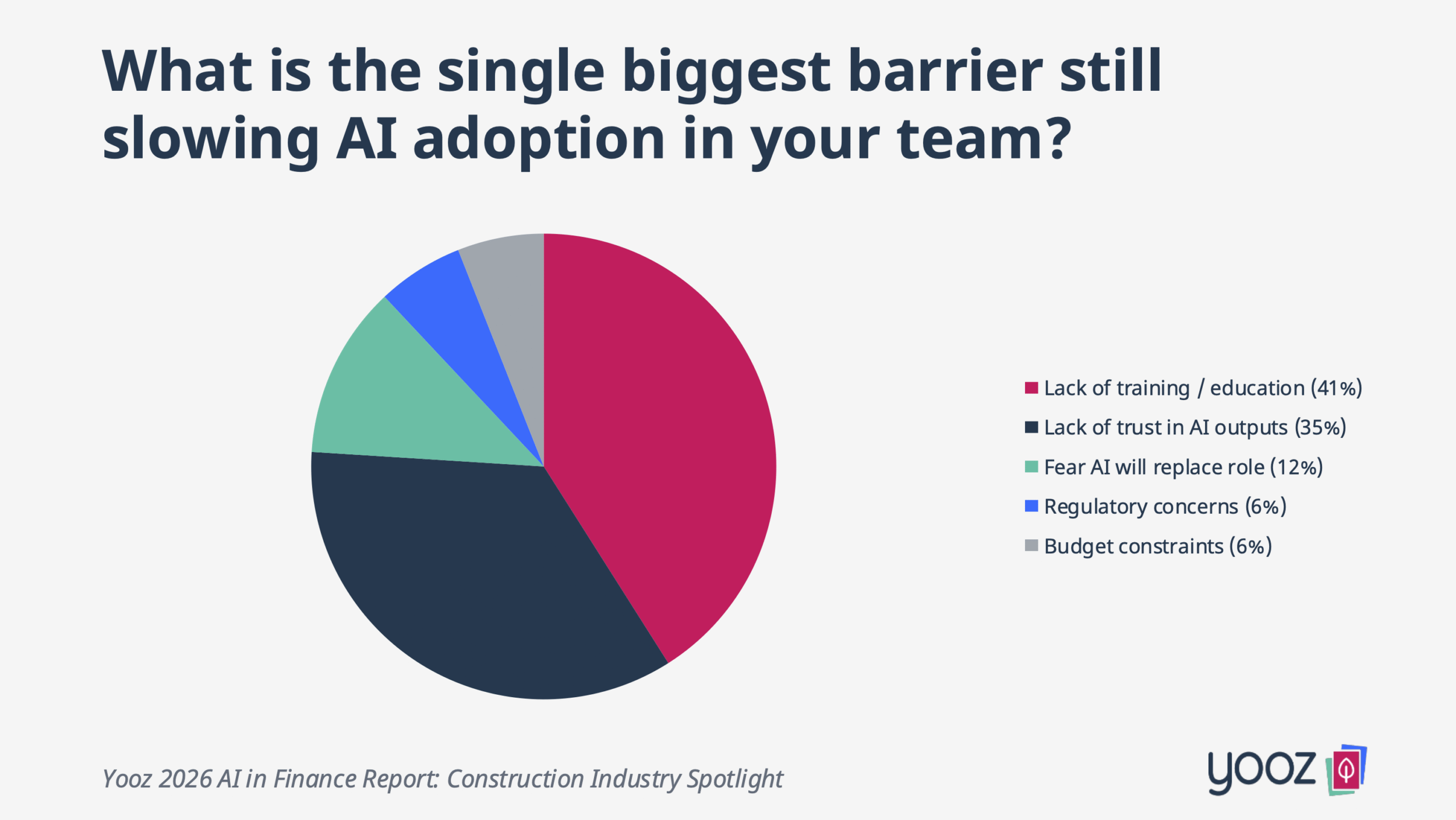
By contrast, budget constraints (6%) and regulatory or compliance concerns (6%) are barely mentioned. Cultural resistance doesn’t register at all. This is an encouraging signal: the barriers in construction finance are not structural. They are solvable through better education and tools that produce verifiable, trustworthy results.
Addressing training and trust together creates a reinforcing cycle. When teams understand how AI works within their specific workflows, and when the tools they use produce outputs they can verify, adoption moves from scattered experimentation to embedded capability. The investment in enablement is what turns AI availability into AI impact.
Individual contributors are building momentum from the ground up
Across all industries, IT or technology teams are most often named as the primary driver of AI adoption (24%), with executive leadership, the CEO, and CFOs each playing a role. But when it comes to who actually seems most confident using AI day to day, construction looks different from the broader finance landscape. In construction, 47% of respondents point to individual contributors as the most confident, nearly double the 24% rate across all finance teams.
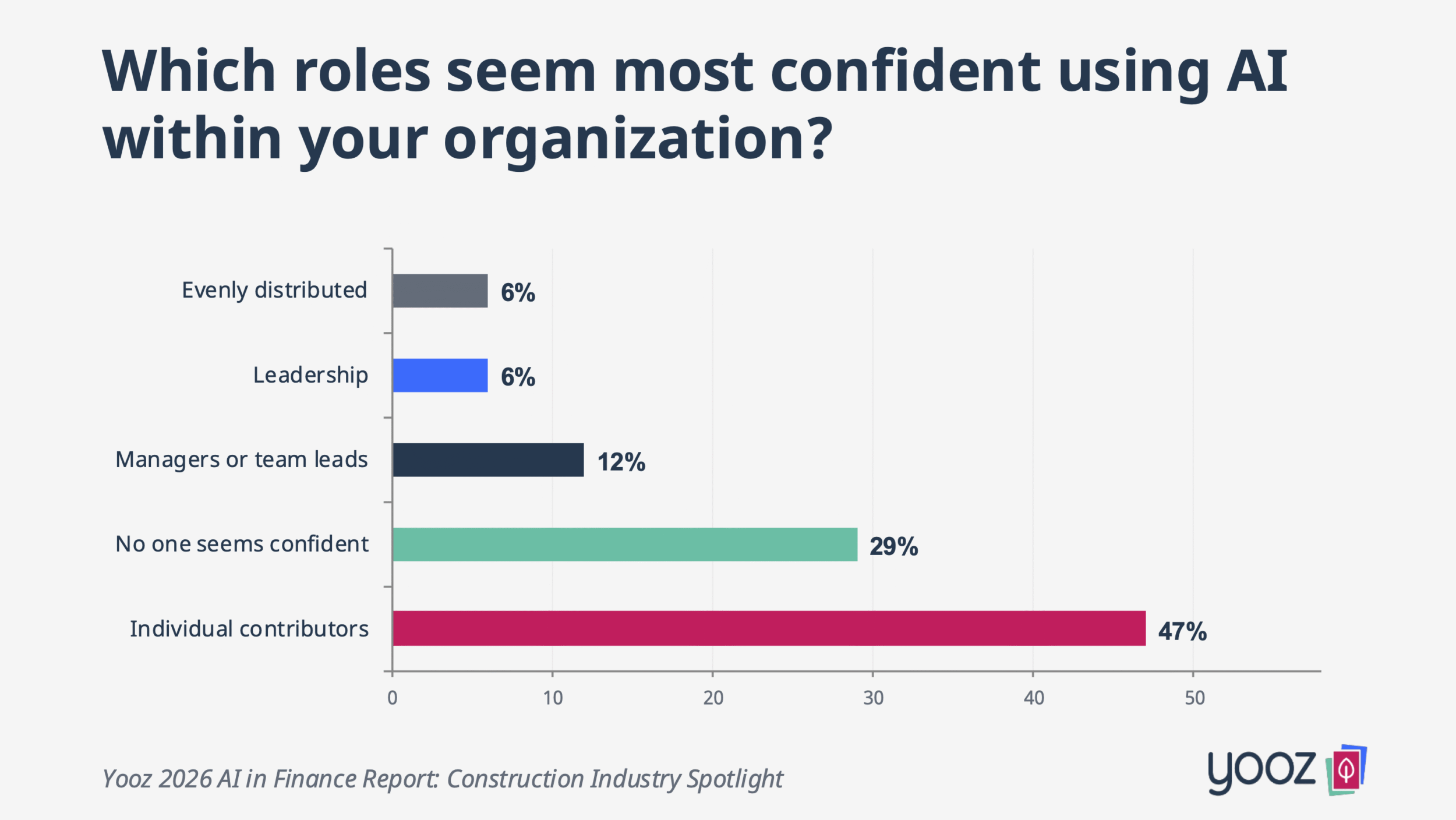
That ground-level confidence is a valuable asset. It means construction finance teams already have people who are comfortable with AI and willing to champion it. The next step is pairing that bottom-up energy with visible leadership support and a shared strategy. When individual initiative meets organizational direction, adoption scales faster and more consistently.
At the same time, 29% of construction respondents say no one in particular is playing the biggest role in driving AI adoption at their organization. As finance leadership becomes more visibly accountable for AI-enabled workflows, that energy from individual contributors can be channeled into coordinated, workflow-level progress.
Construction teams see the opportunity ahead among a growing competitive gap
Nearly half of construction finance professionals (47%) agree that peers in their industry are further ahead with AI, compared to 33% across all industries. That awareness is a catalyst: construction teams recognize the shift happening around them and are motivated to move.
And the outlook is optimistic. Nearly 6 in 10 (59%) expect their team to be more advanced with AI within a year, compared to 46% of finance professionals overall. Just 12% are unsure, and none expect to fall behind.
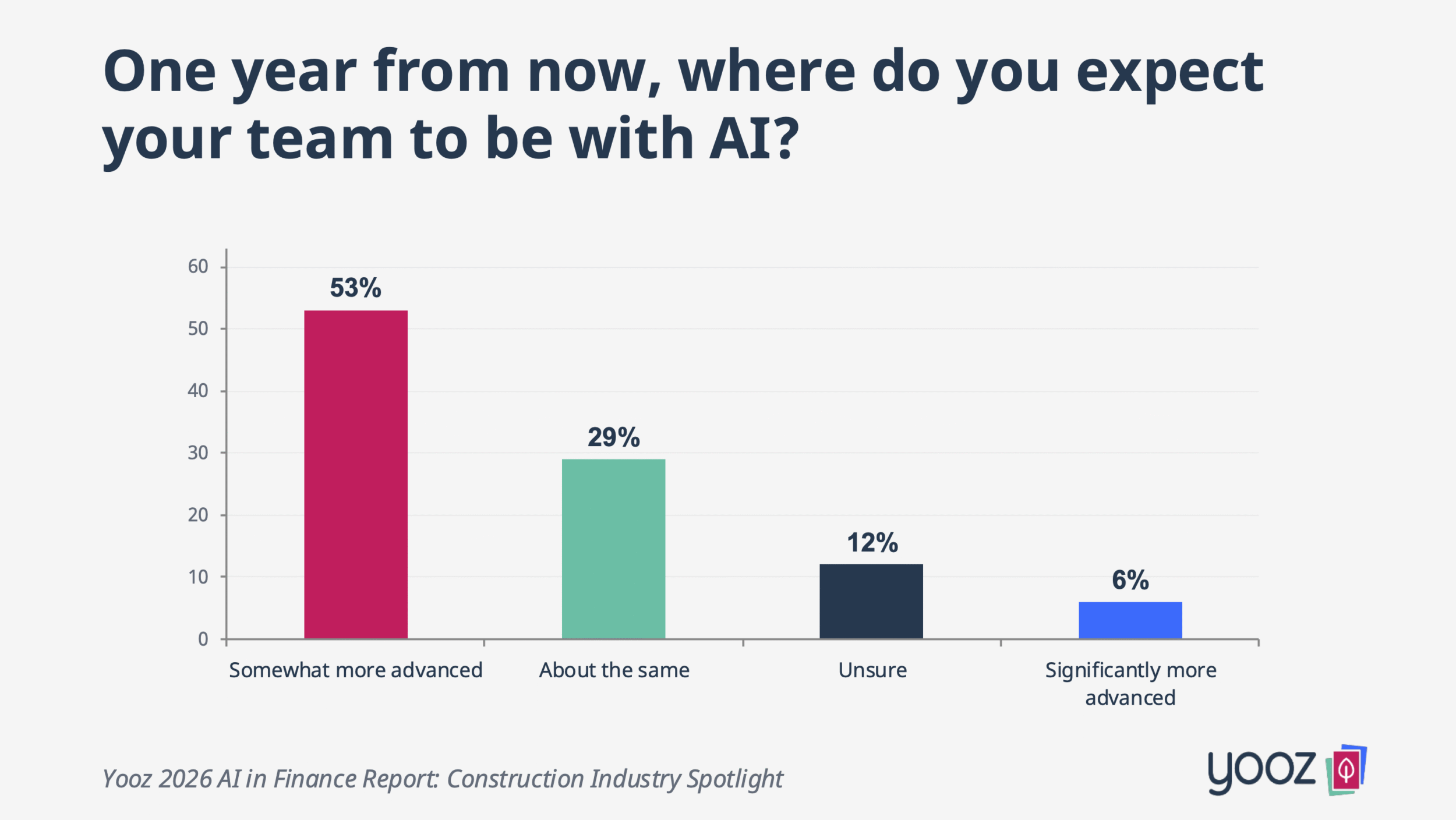
Similarly, 53% of construction respondents agree that finance teams that delay AI adoption will struggle to keep up over time. The combination of competitive awareness and forward-looking confidence suggests construction is at an inflection point, where the teams that invest in training, trust, and workflow integration now will be best positioned to lead.
How construction finance teams can accelerate from here
The data points to a clear opportunity for construction finance teams. The interest is there. The confidence is growing. And the barriers they face, training gaps and output trust, are solvable when AI is embedded directly into the workflows teams already rely on.
In construction finance, where teams manage high-volume payables, complex project accounting, and multi-entity vendor relationships, the entry points for AI are well defined. Automated invoice capture, anomaly detection, duplicate flagging, and vendor matching can all operate within existing AP workflows. When AI is applied to tasks like these, where results are verifiable and the impact is measurable, teams build trust through direct experience rather than training alone.
The shift from experimentation to embedded capability doesn’t require construction finance teams to become AI experts. It requires tools that work reliably inside their existing processes, paired with practical education that shows what AI can and can’t do. When teams see AI catch a duplicate invoice or flag an unusual vendor pattern, they don’t need to be convinced of the technology. They see it working. The next step is a focused one: start with the highest-volume, most-repetitive workflows, embed AI there, and let results build the case for expansion.
“For construction finance teams, the real test of AI is whether it improves execution,” said Yooz CEO Laurent Charpentier. “Lean Financial Operations take shape when teams remove avoidable manual work, build more consistent processes, and apply automation where the value is clear and repeatable. The organizations that move first will be the ones that turn early AI momentum into stronger performance, better control, and lasting operational advantage.”
The Yooz 2026 AI in Finance Report surveyed 500 finance professionals via the third-party survey platform Pollfish in January 2026. Respondents provided insights on their self-reported perceptions of AI usage and readiness, including adoption stage, use cases, perceived benefits, and barriers. Construction industry findings are directional and presented in comparison to the full survey population for context.
Contacts
Media Contact
Idea Grove