


Accounts Payable (AP) is no longer just a back‑office task. Today, it sits at the center of financial strategy, shaping cash flow, vendor relationships, risk management, and real‑time visibility into company spend at every level.
For organizations still running manual accounts payable processes, the pain is familiar: approval delays, limited insight into outstanding liabilities, and processing costs that quietly add up. Modern accounts payable strategies take a very different approach. They focus on automation, standardized workflows, and real‑time visibility that help finance teams stay accurate, timely, and firmly in control.
This guide walks through what accounts payable means in accounting, shares the best practices used by high‑performing finance teams, and explores how to manage AP effectively in today’s increasingly complex financial environment.
What Is Accounts Payable in Accounting?
At its core, accounts payable refers to the money a business owes vendors for goods or services that have been received but not yet paid. From an accounting perspective, it appears on the balance sheet as a current liability, but its role in the business extends far beyond a simple financial entry.
In practice, AP management encompasses the entire invoice-to-payment lifecycle, from invoice capture and approval workflows to payment processing, vendor communication, compliance monitoring, and audit documentation. Done effectively, it helps businesses maintain strong vendor relationships, improve cash flow visibility, reduce risk, and support more efficient financial operations using end-to-end accounts payable automation platforms.
When managed well, accounts payable becomes one of the most reliable levers finance teams have to:
- Control cash flow and working capital
- Avoid late fees, duplicate payments, and errors
- Capture early‑payment discounts
- Reduce fraud and compliance risk
- Build stronger, more predictable vendor relationships
The challenge is that manual AP processes rarely scale. As invoice volumes grow, small inefficiencies quickly turn into backlogs, blind spots, and unnecessary risk, a challenge the Institute of Financial Operations and Leadership (IFOL) consistently highlights in its Accounts Payable Trends research.
Why Accounts Payable Strategies Matter More Than Ever
Today’s finance teams are expected to move faster, improve accuracy, and deliver better insight, often without additional headcount. Because of that pressure, payables management has shifted from a transactional function to a strategic one.
Effective accounts payable strategies help businesses forecast cash more accurately, strengthen internal controls, reduce risk, and maintain stability during periods of economic uncertainty. They also create cleaner, more reliable financial data that leadership teams can actually use. This is especially true when AP data is centralized and visible, a theme reinforced in independent AP research from IFOL and broader industry analysis from PYMNTS Intelligence.
Across industries, the most effective accounts payable management strategies tend to focus on five core priorities:
- Automating repetitive, manual tasks
- Improving real‑time visibility into liabilities and cash flow
- Standardizing approval workflows
- Strengthening internal controls and audit readiness
- Using AP data to guide smarter financial decisions
This is why many organizations are moving away from paper invoices, email chains, and spreadsheets toward automated, AI‑supported AP workflows (especially those delivered through cloud-based AP automation). Automation speeds processing, reduces errors, and gives finance teams immediate insight into where money stands and where it’s going.
Best Practices for Accounts Payable
Automate Invoice Processing
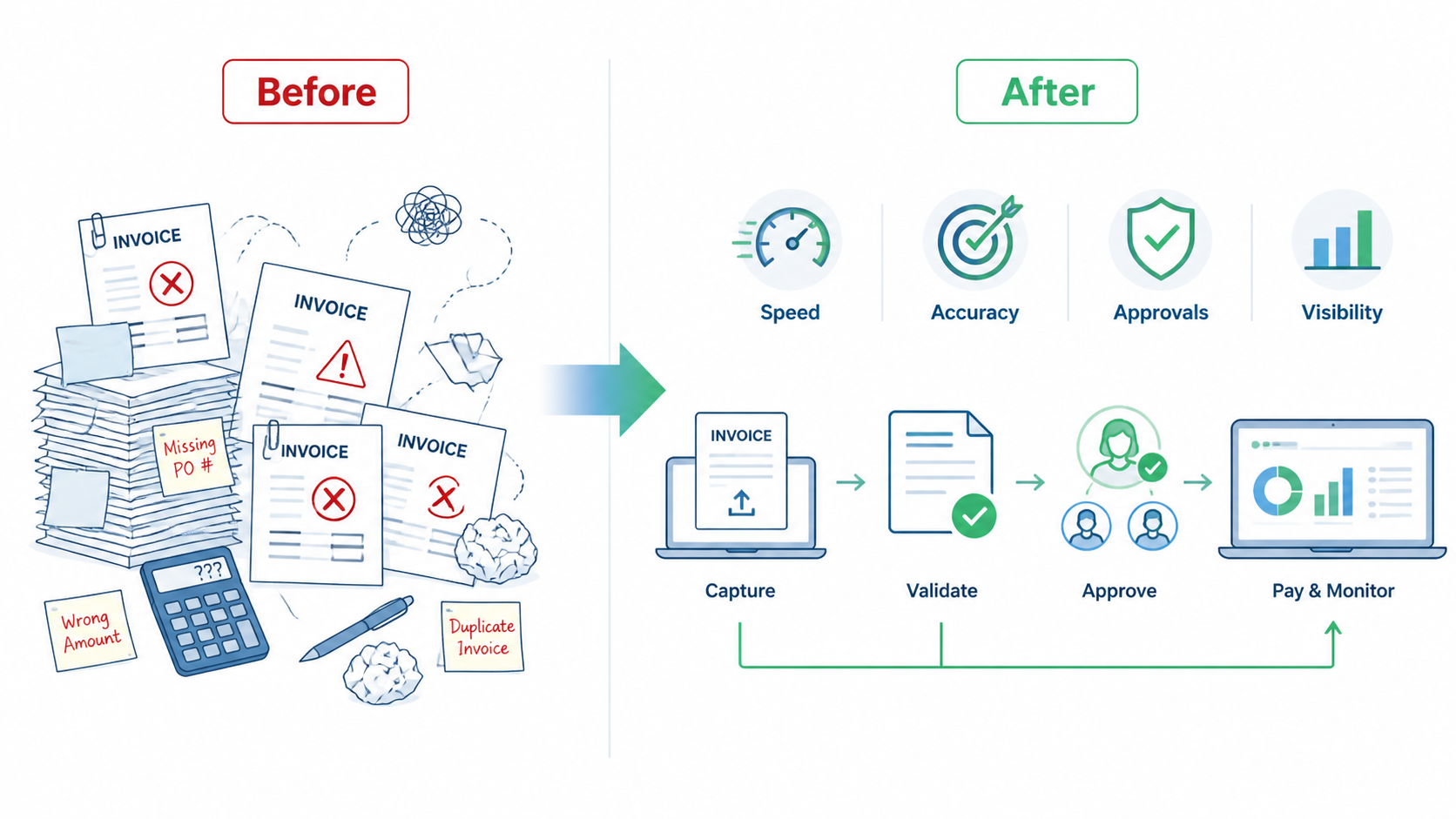
Manual invoice handling slows everything down. Automated invoice processing software accelerates capture, routes invoices automatically for approval, and creates a clear audit trail. The result is faster cycle times, fewer errors, and full visibility from receipt to payment.
Improve Cash Flow Visibility
Knowing what you owe and when is one of the most valuable things AP can offer the business. Real-time dashboards give finance teams instant access to outstanding liabilities, upcoming payments, approval bottlenecks, and early payment discount opportunities, making forecasting and working capital decisions significantly more accurate.
Standardize Approval Workflows
Inconsistent approvals cause delays and opens the door to compliance risk. Standardized, rule-based workflows route invoices automatically based on amount, department, or vendor, improving accountability and cycle times without sacrificing control.
Strengthen Vendor Relationships
Late payments and unclear communication damage vendor trust. Accounts payable best practices help finance teams pay on time, resolve issues faster, and keep vendor interactions centralized and transparent. Strong vendor relationships also offer flexibility when supply chain or economic pressures arise.
What is the Best KPI for Accounts Payable?
Research from APQC shows there is no single “best” KPI for accounts payable. Instead, top‑performing AP teams track a balanced set of core metrics to measure performance accurately. However, APQC’s benchmarks consistently highlight three foundational KPIs: cost per invoice, invoice cycle time, and first‑time error‑free payment rate. Viewed together, these metrics reveal whether AP is reducing cost without sacrificing speed or control.
Reduce Fraud and Compliance Risk
Accounts payable remains a prime target for fraud, especially in manual environments. Role‑based access, segregation of duties, automated approvals, and complete digital audit trails are all essential accounts payable best practices for minimizing duplicate payments, unauthorized vendor changes, and compliance gaps. This is reinforced by finance operations research organizations like Ardent Partners, which consistently highlights the link between automation, stronger controls, and reduced AP fraud risk.

Did You Know?
68% of organizations experienced at least one AP fraud attempt in the past year, most tied to manual processes and weak controls.
How to Manage Accounts Payable Effectively
Managing accounts payable effectively starts with evaluating the full invoice-to-payment process to identify where inefficiencies, delays, errors, or risks may be impacting performance.
Finance teams should ask questions such as:
- Which parts of the process are still manual?
- Where do invoice approvals tend to stall?
- Are vendors consistently being paid on time?
- Is AP fully integrated with the ERP system?
- How easily can teams access invoice and payment data?
Once any gaps are visible, improvements become easier to prioritize, whether that means automation, better reporting, tighter controls, or improved workflows. The goal isn’t just efficiency but building a scalable payables management process that supports better financial decisions across the business.
Choosing the Right AP Automation Platform
Not all AP software delivers the same results. The most effective platforms support end‑to‑end accounts payable management, covering invoice capture, approvals, payments, and reporting in one connected system instead of piecing together disconnected tools.
When evaluating solutions, look for capabilities such as:
- AI‑based invoice capture
- Automated approval workflows
- ERP integration
- Payment automation
- Real‑time reporting and dashboards
- Mobile access
- Built‑in fraud controls
Cloud-based AP automation platforms like Yooz have made this level of sophistication far more accessible, helping mid‑sized organizations achieve levels of visibility and control that were once limited to large enterprises.
Why Businesses Choose Yooz
Yooz offers end‑to‑end accounts payable automation focused on simplifying AP workflows while improving visibility and control. Finance teams use Yooz to automate invoice processing, standardize approvals, gain real‑time insight into payables, and strengthen compliance. Its broad ERP integrations make it easier to modernize AP without disrupting existing systems, processes, or workflows.
Final Thoughts
Strong accounts payable management is no longer optional. With growing invoice volumes, tighter margins, and rising fraud risk, finance teams need speed, visibility, and control built into every step of the payment process.
The good news is that the tools and best practices to get there are more accessible than ever. Businesses that invest in modern AP management are not just reducing bottlenecks. They are turning payables management into a genuine strategic advantage that supports smarter decisions, stronger vendor relationships, and healthier cash flow across the business.

Personalized demo
Discover Yooz, the smartest, most powerful, and easiest-to-use solution!
FAQs for Accounts Payable Strategies
What is accounts payable in accounting?
Accounts payable is the money a business owes vendors for received goods or services. It’s recorded as a current liability and managed through invoice approvals and payments.
Why is accounts payable management important?
Effective accounts payable management improves cash flow control, reduces fraud risk, avoids late payments, and provides real‑time visibility into liabilities and spending.
What are best practices for accounts payable?
Accounts payable best practices include automating invoices, standardizing approvals, improving cash flow visibility, and using strong internal controls to reduce errors and compliance risk.
How can businesses manage accounts payable more effectively?
Businesses manage accounts payable more effectively by using AP software that supports automation, ERP integration, real‑time reporting, and built‑in controls across the entire payment lifecycle.

Additional Resources

Navigating Accounts Payable Remote