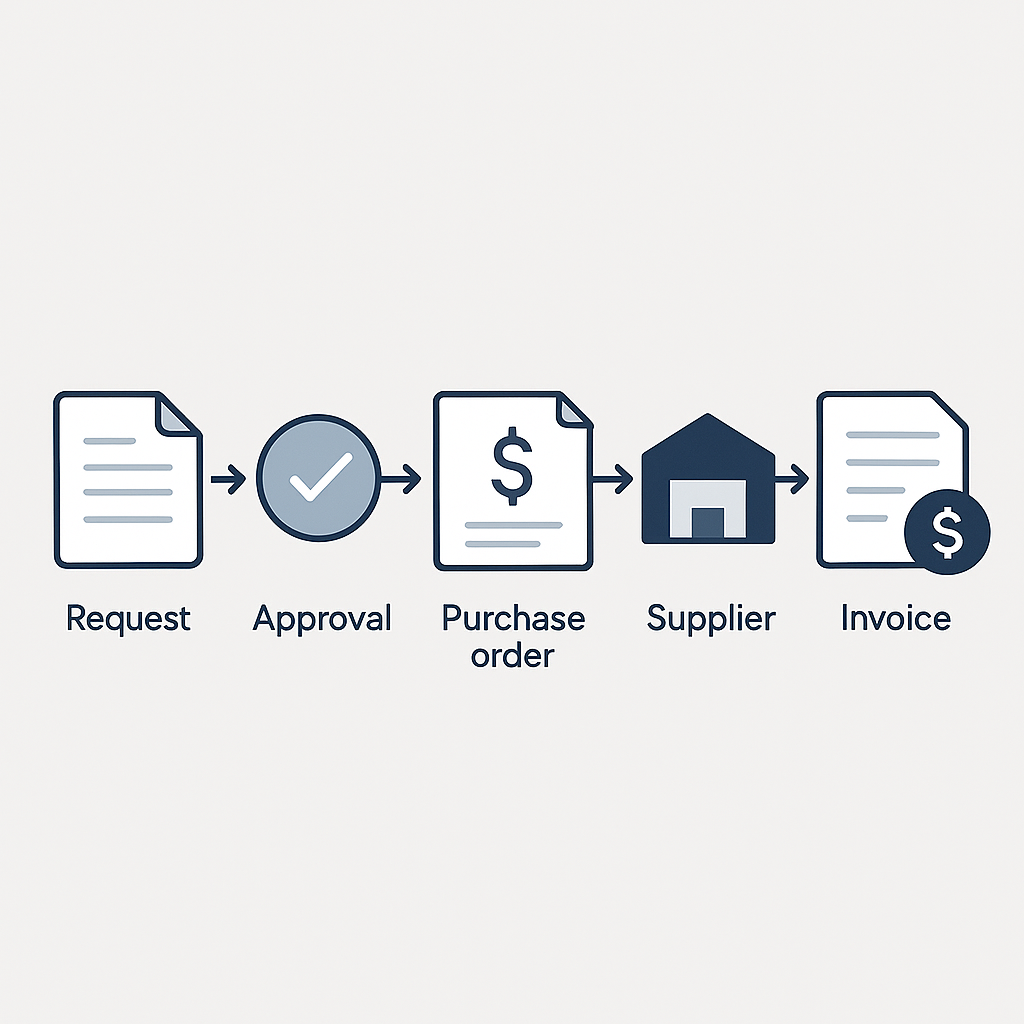


Strengthening Purchase Order & Invoice Control
Purchase orders play a critical role in procurement discipline and financial control. Organizations that follow structured purchase order best practices gain:
- Better spending visibility
- Faster invoice processing
- Fewer invoice discrepancies
- Stronger vendor relationships
- Improved audit readiness
As invoice volumes grow, manual procurement processes become difficult to manage. By strengthening the connection between every purchase order and invoice, organizations create a more efficient and reliable purchase-to-pay process.
Automation platforms such as Yooz help organizations scale purchase order and invoice matching processes while maintaining strong financial controls.
Mismatched invoices. Unauthorized spending. Weeks lost chasing approvals. If any of these sounds familiar, your purchase order process is probably costing you more than you realize in time, money, and vendor goodwill.
This guide covers everything finance and procurement teams need to know: what a purchase order really does, how an efficient PO process flows, and which best practices – including line-level matching – separate high-performing AP teams from the rest. You’ll also see how modern platforms like Yooz put these practices on autopilot.
What Is a Purchase Order?
A Purchase Order (PO) is your company’s official, legally binding authorization to a vendor. It documents exactly what you’re buying: item descriptions, quantities, agreed prices, delivery dates, and payment terms. Once the vendor accepts it, you have a contract that protects both parties.
The four main PO types cover every procurement scenario:
- Standard POs: One-off purchases with fully defined details.
- Blanket POs: Ongoing purchasing from a single vendor within a set spending cap.
- Contract POs: Tied to a master agreement; quantities vary but terms are fixed.
- Planned POs: Forecast future needs and finalize details as delivery dates approach.
Regardless of type, every PO serves the same core purpose: creating a clear, auditable record that ties every purchase order and invoice together for accurate reconciliation.
How important is PO standardization? Federal guidance under the GSA Acquisition Manual (Part 513) stresses consistent PO forms and documentation for accurate purchasing and audit readiness.
Why Purchase Orders Are a Financial Control Essential
Without POs, spending happens in the dark. With them, every dollar is authorized before it leaves your account. Here’s what that means in practice:
- Budget enforcement: POs require approval before commitment, preventing maverick spending and keeping cash flow forecasts accurate.
- Vendor alignment: Detailed POs set clear expectations on quantities, timelines, and pricing, giving vendors what they need to deliver reliably.
- Risk reduction: Documented terms prevent scope creep, price disputes, and delivery failures. Embed compliance requirements directly into POs to stay audit ready.
- Faster payments: Clean PO and invoice matching means fewer disputes and shorter payment cycles, which strengthens vendor relationships.
Public-sector procurement frameworks support the same principles of spend control and auditability. One such example is the Federal Procurement Standards in 2 CFR 200 that requires documented procurement procedures and contractor oversight.
The Purchase Order Process: Step by Step
A well-run PO process follows five clear stages:
- Requisition: An employee identifies a need and submits a purchase request with item details, estimated cost, and preferred vendor.
- Approval workflow:The request routes automatically based on value and category for budget and compliance review. Automated approval routing removes bottlenecks without sacrificing control.
- PO creation and issue:The approved requisition converts to a formal PO using a standardized template. Delivery instructions, cost codes, and payment terms are included. The vendor acknowledges receipt.
- Fulfillment and goods receipt:Goods or services are delivered. The receiving team verifies the delivery against the PO and records any discrepancies.
- Invoice matching and payment: AP performs a three-way match: purchase order, goods receipt, and vendor invoice. Clean matches flow straight to payment. Discrepancies are resolved before payment is released.
Purchase Order Best Practices That Actually Move the Needle
Standardize Every PO Template
Inconsistent PO formats are a root cause of invoice mismatches. Every PO should include item descriptions, units of measure, unit prices, delivery dates, ship-to addresses, payment terms, applicable taxes, and GL codes. Consistency at creation prevents errors downstream.
Enforce a No-PO, No-Pay Policy
If an invoice arrives without a corresponding PO, it doesn’t get paid. This policy closes the door to off-contract purchases, rogue spending, and vendor invoice submissions that bypass proper authorization.
Communicate Proactively with Vendors
Share POs promptly. Issue formal amendments for any changes. Never accept verbal modifications. Review vendor performance regularly against PO terms to identify patterns and resolve issues before they escalate.4. Implement Line-Level Matching
This is where most organizations have the biggest untapped opportunity. More on this in the next section.
Maintain Clean Master Data
Vendor records, product catalogs, and contracted pricing must be kept current. Research shows that outdated or inconsistent vendor information directly undermines process accuracy, leading to preventable errors such as invoice mismatches.
Line-Level Matching: The Key to Invoice Accuracy at Scale
Most organizations know about three-way matching (comparing the PO, goods receipt, and vendor invoice). Fewer have moved beyond header-level validation to true line-level matching. That gap is expensive.
Header-level matching checks whether the total invoice amount is close to the total PO value. It catches obvious errors, but it misses the ones that cost you most: a line item priced 12% above the agreed rate, a quantity billed that was never received, a freight charge that doesn’t match PO terms.
Line-level matching solves this by validating every individual line item against both the purchase order and the goods receipt. For each line, the system checks:
- Item descriptions match the PO
- Quantities invoiced align with quantities ordered and received
- Unit prices match contracted or approved rates
- Taxes, freight, and surcharges correspond to PO terms
- Discount structures reflect vendor agreements
Why Line-Level Matching Changes the Game for AP Teams
Fewer exceptions, handled faster
When discrepancies are caught at the line-level before an invoice enters the payment queue, you eliminate the back-and-forth of investigation after the fact. AP teams stop firefighting and start processing.
Straight-through payment processing
Invoices where every line checks out can be approved automatically with no human touch required. This compresses payment cycles from weeks to days and frees your AP team for higher-value work.
Stronger financial controls
Granular validation means vendors can only invoice for exactly what was ordered and received. Pricing errors, duplicate charges, and unauthorized line items are blocked before payment, not discovered during audit.
Audit-ready transparency
Every payment is traceable to a specific PO line, goods receipt, and approved invoice line. When auditors come knocking, the trail is already there.
Better vendor relationships
When a discrepancy occurs, line-level matching tells you exactly which line caused the issue. Disputes are resolved faster, with precision, and without the friction of questioning an entire invoice.
From Manual Processes to Automated AP: Where Technology Fits
Spreadsheets and manual approval chains can’t scale with invoice volume. Modern AP automation platforms eliminate the bottlenecks built into manual PO processes.
When combined with AP automation, line-level matching enables:
- Automatic invoice validation against PO and receipt data
- Real-time exception detection with flagging and routing
- Faster approval cycles and payment release
- Full spend visibility across entities, locations, and categories
- Measurable reduction in cost-per-invoice processed
Yooz brings all of this together in a single platform, from catalog-driven purchase requests and smart approval workflows to AI-powered invoice capture and line-level three-way matching. Finance teams using Yooz see fewer exceptions, faster processing, and stronger controls without adding headcount.
Whether you’re processing hundreds of invoices a month or hundreds of thousands, Yooz scales with your operation. Real-time analytics give you full visibility into spend, vendor performance, and process efficiency.
Key Takeaways
- Purchase orders are the backbone of spend control. They authorize purchases, create audit trails, and enable accurate invoice reconciliation.
- A structured PO process (requisition → approval → issue → receipt → matching) minimizes exceptions and payment delays.
- Standardized templates, no-PO-no-pay policies, and proactive vendor communication are the foundations of strong PO management.
- Line-level matching goes beyond totals to validate every invoice line against the PO and goods receipt, catching discrepancies before payment.
- AP automation platforms like Yooz combine line-level matching with AI-powered workflows to deliver faster, more accurate invoice processing at any scale.
Ready to see line-level matching and intelligent PO management in action? Learn more about purchase order management best practices? Contact Yooz to get a personalized demo and discover how your AP team can process invoices faster, with fewer exceptions and stronger controls.

Personalized demo
Discover Yooz, the smartest, most powerful, and easiest-to-use solution!
FAQs
What is the purpose of a purchase order?
A purchase order authorizes a vendor to deliver goods or services and documents the agreed terms of the transaction. It helps organizations control spending and verify invoices before payment.
What is three-way matching?
Three-way matching compares the purchase order, goods receipt, and vendor invoice to ensure details align before payment is issued.
What is line-level matching?
Line-level matching verifies each invoice item against the corresponding purchase order line rather than only comparing totals.
Why do companies implement a No-PO No-Pay policy?
A No PO No Pay policy ensures purchases follow proper approval workflows and prevents unauthorized spending.

Additional Resources

The Power of the Digital Invoice