

Finance leaders are investing in AI-powered accounts payable automation, intelligent document processing, predictive analytics, and workflow automation at an unprecedented pace. Pilot programs have become enterprise initiatives. Budgets have been approved. Systems have been implemented. Go-live celebrations have come and gone.
Yet many finance executives find themselves asking a surprisingly familiar question just a few months later:
Why Aren’t We Seeing the Return We Expected?
It’s an uncomfortable question because implementation has been successfully completed. The software works. Data is flowing. Dashboards are populated. Vendors have delivered on their promises.
But somewhere between deployment and measurable business impact, momentum slows.
The reality is this: Technology enables change. Adoption delivers results.
That’s the difference many organizations underestimate.
AI Adoption Is Growing. Business Impact Isn’t Keeping Pace.
There’s no shortage of evidence that AI adoption is accelerating.
According to Yooz’s 2026 AI in Finance research, 67% of finance organizations are already using or piloting AI, yet only 10% say AI is fully embedded into their core financial processes. In other words, most organizations have started the journey, but very few have completed it. External research points to the same conclusion.
Boston Consulting Group (BCG) recently described this challenge as the “AI adoption puzzle“, noting that while AI usage continues to rise, many organizations still struggle to translate that usage into measurable business impact.
Gallup has reached a similar conclusion. Employees are increasingly experimenting with AI, but many still lack clear guidance, confidence, and organizational support for integrating it into everyday work.
The pattern is remarkably consistent: Organizations aren’t failing to buy AI, they’re struggling to adopt AI operationally.
Those are two very different things.
The False Finish Line
One of the biggest misconceptions in digital transformation is treating implementation as the finish line. It isn’t. Implementation is simply the moment your technology becomes available. Adoption is the moment your organization begins changing how work gets done.
I’ve seen finance teams invest months evaluating software, preparing integrations, migrating data, and managing implementation projects. Then something interesting happens: invoice approvers continue approving invoices through email, exceptions are still handled through hallway conversations, employees copy information into spreadsheets “just to be safe,” and managers override AI recommendations without understanding why they were made.
None of those behaviors mean the software failed. They simply mean the organization never stopped working the old way.
Technology has changed. The operating habits didn’t.
AI Adoption Is Really About Behavior Change
Organizations often describe AI as a technology initiative, but I think that’s only part of the story. AI implementation is a technology project. AI adoption is a behavior change initiative.
Every successful implementation eventually becomes a people project.
Once the system is live, employees make a series of decisions that determine whether adoption succeeds or stalls. Will they follow the new workflow? Will they trust the recommendation? Will they stop relying on spreadsheets? Will they change processes they’ve used for years?
Those aren’t technical decisions. They’re behavioral ones.
That’s why change management deserves a much larger role in every AI implementation. Long-term success depends less on whether technology works and more on whether people embrace new ways of working.
Lasting AI ROI is created when behavior change sticks.
Download the eBook
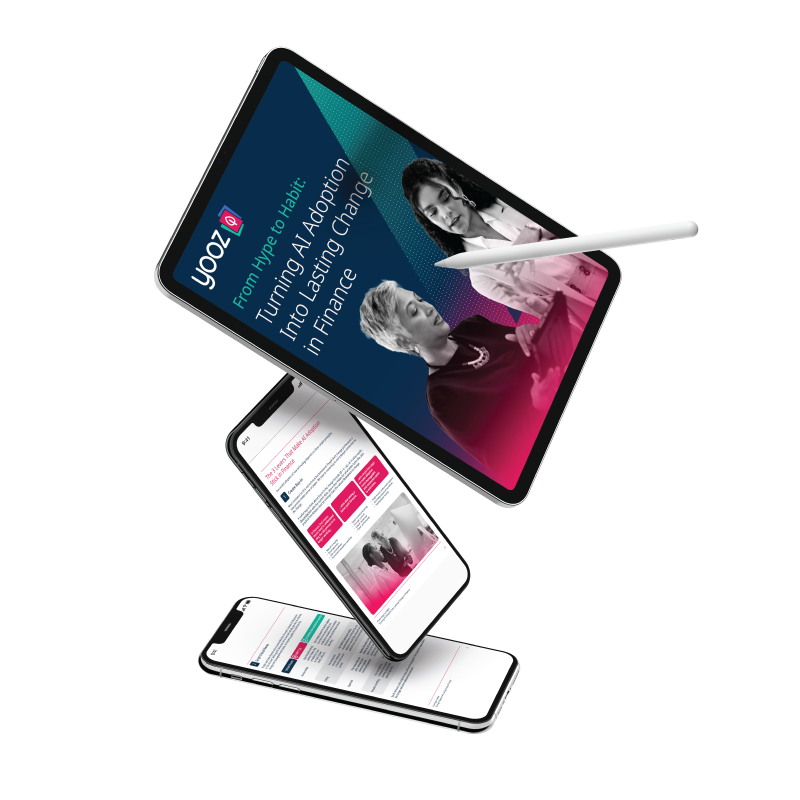
If you’re leading AI adoption within your finance organization, our eBook From Hype to Habit: Turning AI Adoption Into Lasting Change in Finance explores practical strategies for closing the gap between implementation and measurable business outcomes. It includes a proven adoption framework, finance-specific examples, and a practical worksheet your team can begin using immediately.
Why AI ROI Stalls
When finance leaders say they aren’t seeing the expected return from AI adoption, the underlying issues usually have very little to do with the technology itself.
Instead, the conversation often sounds familiar:
- “Some people use the platform while others don’t.”
- “Managers aren’t reinforcing the new process.”
- “Employees still trust spreadsheets more than the system.”
- “Training happened once during implementation and never again.”
- “Whoever owned adoption during rollout has moved on to the next project.”
Notice the pattern.
These aren’t software problems. They’re leadership and change management challenges.
The Yooz 2026 AI in Finance eBook highlights several common barriers that could emerge after go-live. Employees may be hesitant to trust AI-generated recommendations, teams may use new workflows inconsistently, and ownership of adoption efforts often becomes unclear over time. In many organizations, training ends after implementation, leaving employees without the reinforcement needed to build new habits.
At the same time, informal workarounds begin to creep back in. Employees revert to spreadsheets, email chains, or manual processes that bypass the system altogether. While these behaviors may seem minor on their own, they gradually undermine standardization, visibility, and the efficiencies the organization expected to achieve.
None of these challenges appear on an implementation checklist, yet every one of them has a direct impact on ROI.
Finance Teams Think Differently. That’s a Strength.
Finance professionals are trained to question information before acting on it, and that’s exactly what makes great finance organizations. Accuracy matters. Compliance matters. Risk management matters.
Ironically, those same strengths can slow AI adoption when leaders assume employees will automatically trust a new system simply because it’s available. Finance teams don’t embrace new technology because they’re told to. They embrace it when it consistently proves its value.
Trust isn’t built during implementation. It’s built through consistent experience.
Confidence grows with every successful recommendation, every exception handled correctly, every month-end close that finishes faster, and every audit trail that removes uncertainty. Each positive outcome reinforces the idea that the system can be trusted to support critical financial processes without sacrificing control.
Over time, skepticism gives way to confidence. And when confidence grows, adoption accelerates.
The Real Driver of AI ROI
One of the most interesting things we’ve observed is that organizations generating the strongest returns often don’t use dramatically different technology than everyone else. Instead, they:
- Manage adoption differently.
- Communicate expectations clearly.
- Reinforce desired behaviors consistently.
- Remove friction from everyday workflows.
- Celebrate early wins.
Most importantly, they make adoption someone’s responsibility rather than everyone’s responsibility. In other words, they recognize that implementation has an end date. Adoption doesn’t.
From AI Curiosity to AI Operationalization
The conversation around AI has matured. A few years ago, organizations wanted to know whether AI worked. Today, most finance leaders accept that it does. The more important question is:
How do we make AI part of the way finance operates every single day?
That’s where competitive advantage is created. Not through experimentation, headlines, or another pilot project. Through operational discipline.
The organizations that consistently realize ROI don’t simply implement AI. They build environments where using AI becomes the easiest, most natural way to work. That shift doesn’t happen by accident. It happens because leaders intentionally design for adoption.
The Real Opportunity for Finance Leaders
Finance transformation is about more than just technology. It’s about creating more efficient processes, better controls, stronger visibility, and a better experience for employees and vendors alike. AI can accelerate those outcomes, but only if people use it.
As finance leaders, we spend enormous amounts of time selecting platforms, evaluating vendors, building business cases, and planning implementations. Those activities matter. But the real work begins after go-live.
The organizations that outperform their peers won’t necessarily be the ones that purchased the most sophisticated AI. They’ll be the ones that helped their people embrace it. Because while technology enables change, adoption delivers results.
AI Adoption FAQs
What is AI adoption?
AI adoption is the process of integrating artificial intelligence into everyday business operations so employees consistently use it to improve decisions, workflows, and outcomes. Successful AI adoption goes beyond implementation by changing how work is performed across the organization.
How long does AI adoption take?
Implementation may take weeks or months, but meaningful AI adoption typically continues long after go-live. Organizations that achieve lasting results reinforce new behaviors through training, leadership support, performance measurement, and continuous improvement.
Why does AI adoption fail?
Most AI initiatives don’t fail because the technology doesn’t work. They struggle because organizations underestimate the people side of change. Common barriers include low trust, inconsistent workflows, insufficient training, unclear ownership, and resistance to changing established habits.
What are the core components of successful AI adoption?
Successful AI adoption combines executive sponsorship, clear communication, user training, defined workflows, accountability, and ongoing reinforcement. When people, processes, and technology work together, organizations are far more likely to achieve measurable business value.

Additional Resources