


According to APQC, the total cost to process a single purchase order ranges from about $14 to more than $54, depending on process maturity and the degree of automation in place. For organizations managing hundreds of purchase orders each month, that gap is not a minor inefficiency. It is a measurable operational cost that compounds at scale.
The purchase order process is where spending is either controlled or lost and strong purchase order management is what closes that gap. When the steps are unclear or inconsistently applied, approval delays accumulate into procurement bottlenecks, invoices arrive that cannot be matched against what was authorized, and budget visibility requires someone to compile a report rather than pull real-time data.
What Is a Purchase Order?
A Purchase Order (PO) is a formal document issued by a buyer to a vendor authorizing a specific purchase of goods or services. It defines what is being ordered, the quantity, the agreed price, and the applicable payment and delivery terms. Once a vendor accepts a PO, it becomes a legally binding contract between the parties.
A purchase order is not the same as a purchase requisition (PR). A PR is an internal approval request that remains within the organization. The PO is the external document transmitted to the vendor after internal approval is granted. The two documents serve different control purposes and are managed by different teams.
What Is the Purchase Order Process?
The purchase order process is the structured workflow that governs how an organization buys goods or services, from identifying a need through closing and archiving the completed order. It is one stage within the broader procure-to-pay cycle, which spans vendor selection through final payment reconciliation.
APQC’s procurement benchmarking data shows a wide performance gap in how organizations manage this process, with costs per purchase order ranging from $14 to more than $54 depending on process maturity. For growing teams, a formal purchase order process is the mechanism that creates spend visibility, enforces budget controls, generates a defensible audit trail, prevents fraud, and holds suppliers accountable to agreed terms.
Why the Purchase Order Process Matters
Without a structured purchase order workflow, spending decisions happen outside finance’s view, and the consequences surface later in the form of unauthorized invoices, vendor disputes, and documentation gaps that trigger auditing flags.
According to CAPS Research, organizations without strong PO controls often find that purchasing outside the approved workflow accounts for 20 to 40 percent of total indirect spend. That gap erodes negotiated savings, undermines budget visibility, and removes the documented authorization trail that three-way matching and audit readiness depend on.
The purchase order process is the mechanism that gives finance authority over spend before it leaves the organization.
The Purchase Order Process: 12 Steps from Requisition to Closure
The steps below cover the full purchase order lifecycle from need identification through closure. Each step names who owns it, what the outcome is, and where the process breaks down when it is skipped or compressed
Step 1: Identify the Need
Owner: Department lead or project manager
Outcome: A documented need with specifications
Every purchase order cycle begins before any vendor is contacted. A department or employee identifies a procurement need: low inventory, a new project, a contract renewal. Each requires documentation before the process can advance.
In many organizations, this step happens informally: a quick message or a verbal conversation with nothing recorded. That is where downstream problems begin. Without a documented record of what was requested, by whom, and against which budget, the downstream approval and authorization steps have no reliable foundation.
Step 2: Submit a Purchase Requisition (PR)
Owner: Requesting employee or team lead
Outcome: A formal internal request documented and submitted for approval
A purchase requisition documents what is needed, the estimated cost, and the relevant project or cost center, then routes to the appropriate manager for review before any supplier engagement begins.
Some teams skip this step for recurring vendors, which is defensible at low transaction volumes. As purchasing activity scales, skipping requisitions creates unauthorized spend that is difficult to trace and generates significant audit exposure.
Step 3: Approve the Purchase Requisition
Owner: Department manager or finance lead, depending on purchase amount
Outcome: Authorized approval to proceed with the purchase
Approval logic at most mid-market organizations is tiered by spend value: a direct manager reviews smaller purchases; finance or the controller handles higher-value requests. Documented thresholds are what prevent this step from becoming a bottleneck. When approval rules are informal, requests stall in inboxes and procurement delays compound.
Step 4: Request for Quotation (RFQ) and Vendor Selection
Owner: Procurement or operations lead
Outcome: A selected vendor with agreed pricing and terms
Once a requisition is approved, the procurement team issues a Request for Quotation (RFQ) to one or more suppliers, asking them to provide pricing, lead times, payment terms, and any conditions attached to the quote.
Supplier quotes are evaluated on price, delivery reliability, quality, and relationship history. The winning supplier’s agreed terms carry directly into the PO fields:
- The quoted unit price becomes the PO line-item price.
- The quoted delivery date becomes the PO delivery date.
- The quoted payment terms become the PO payment terms.
This direct handoff is why accurate, detailed RFQs matter. Terms agreed verbally but not documented in the quote will not appear on the PO, creating discrepancies that surface during invoice matching.
Step 5: Create the Purchase Order
Owner: Procurement or AP (Accounts Payable) team
Outcome: A completed PO document with a unique PO number
The procurement or AP team creates the formal PO based on the approved requisition and the supplier’s accepted quote. Each PO is assigned a unique PO number for tracking and downstream matching. The document must include all required fields: buyer and supplier details, line items with descriptions, quantities, unit prices, delivery dates, and payment terms. The Purchase Order Format section below covers each required field.
Step 6: Approve the Purchase Order
Owner: Finance manager, controller, or CFO, based on defined approval thresholds
Outcome: Authorized PO ready for vendor transmission
PO approval validates that the purchase aligns with budget, policy, and prior authorization before it is released to the vendor. While this step often mirrors requisition approval, it typically applies stricter controls at higher spend levels.
Most organizations use tiered approval rules based on predefined spend thresholds rather than fixed amounts. Smaller purchases may route to a department manager, while higher-value POs require review from finance or executive leadership. Clearly defined thresholds prevent bottlenecks and ensure consistent enforcement of controls.
Automated approval workflows route each PO to the appropriate approver in real time, with escalation rules that trigger when approvals are delayed. This ensures the process moves forward without manual follow-up while maintaining full audit visibility.
Step 7: Send the PO to the Vendor
Owner: Procurement or AP team
Outcome: Supplier receives the official purchase order
The approved PO is transmitted to the supplier through one of several channels: email, a supplier portal, EDI (Electronic Data Interchange), or directly through procurement software.
On the supplier side:
- The PO enters their order management system.
- The vendor team reviews it against the original quote.
- The team confirms they can fulfill the order based on the stated terms.
- Any discrepancies are flagged before confirmation.
The vendor-side review matters because disagreements resolved at this stage cost far less than those that surface during goods receipt or invoice matching.
Step 8: Vendor Confirms the PO
Owner: Vendor
Outcome: Legally binding agreement between buyer and supplier
Once a supplier formally accepts the purchase order, it becomes a legally binding contract. The supplier is obligated to deliver the specified goods or services at the agreed price and timeline. If the supplier cannot meet the stated terms, they may request changes before confirming, which requires revised terms to be documented and re-approved internally before the PO is reissued.
Step 9: Receive Goods or Services and Issue a GRN
Owner: Receiving team or operations
Outcome: Verified delivery documented with a Goods Received Note
When goods arrive or services are completed, the receiving team verifies what was delivered against the purchase order and documents it with a Goods Received Note (GRN). The GRN records quantities received, condition, and any discrepancies between what was ordered and what arrived. Any shortfalls or quality issues are flagged before payment proceeds.
Step 10: Three-Way Matching
Owner: AP team
Outcome: Alignment confirmed between PO, GRN, and vendor invoice
Three-way matching cross-references the purchase order, the goods received note, and the supplier’s invoice to confirm that quantities, prices, and terms are consistent across all three documents. When they align, the invoice advances to payment. When they do not, the invoice enters an exception workflow and is held until the discrepancy is resolved.
Three-way matching is the primary financial control against overpayment and invoice fraud in a purchase order environment.
Step 11: Approve the Invoice and Process Payment
Owner: AP team and finance manager
Outcome: Vendor payment released per agreed terms
Once three-way matching is confirmed, the AP team approves the invoice and releases payment according to the terms documented in the original PO. Payment method (ACH, wire transfer, virtual card, or check) is governed by supplier preference and the organization’s payment policy.
Step 12: Close the PO and Archive Records
Owner: AP or procurement team
Outcome: PO marked as complete, records archived for audit
PO closure confirms that delivery is complete and payment has been processed. Clean records underpin tax documentation, audit defense, budget reconciliation, and future vendor negotiations. None of these are reliable when PO history lives across email threads and spreadsheets. Open POs that have been paid but not formally closed create phantom outstanding commitments that inflate liability figures and make spend reporting unreliable.
Purchase Order Format: What Every PO Should Include
Each field in a standard PO supports approval routing, invoice matching, and audit documentation. The table below covers the header fields and why each one matters in practice.
PO Header Fields
| Field | Why It Matters |
|---|---|
| PO Number | Unique identifier for tracking, matching, and auditing. Every downstream document references this number. |
| Issue Date | Establishes the timeline for payment terms, delivery expectations, and contract enforceability. |
| Buyer Contact Info | Ensures the supplier can reach the right person for clarifications, change requests, or delivery coordination. |
| Supplier Contact Info | Confirms the PO is addressed to the correct legal entity and contact. Prevents misdirected orders. |
| Billing and Shipping Addresses | Separate billing and shipping addresses prevent delivery errors and invoice routing failures. |
Line-Item Details
Specificity in line items is what prevents invoice disputes and receiving errors downstream.
- Item description: Must clearly define what was ordered
- Quantity: Must match agreed terms. Partial shipments should reference the original PO quantity.
- Unit of measure: Cases, pallets, units, hours. Any ambiguity here creates disputes.
- Unit price: Taken directly from the accepted vs quote. Must match the approved quote for three-way matching to work.
- Line total: Quantity multiplied by unit price. Serves as a verification check for both buyer and vendor.
Terms and Conditions
Delivery date: The agreed date by which goods or services must be delivered.
- Shipping terms: Who pays for freight, who bears risk in transit (FOB origin vs. FOB destination).
- Payment terms: Net 30, Net 60, or early-payment discount terms. Governs when AP releases payment.
- Special conditions: Return policies, warranty terms, or compliance requirements specific to the order.
Authorization
Every PO must document authorization through a signature, digital stamp, or system record. Without it, there is no audit trail confirming the purchase was reviewed, fit the budget, and approved by the right person.
Types of Purchase Orders
Choosing the right PO type for the purchasing scenario reduces administrative overhead and prevents spending control failures. Using the wrong type is a common and correctable gap at growth-stage companies.
Standard Purchase Order (SPO)
A Standard Purchase Order is a one-time order for specific goods or services, with all details known upfront: items, quantities, prices, and delivery dates. It is the most common PO type and the simplest to manage.
Planned Purchase Order (PPO)
A Planned Purchase Order covers anticipated future purchases where the full scope is known but timing has not been confirmed. Items, quantities, and pricing are locked; the delivery schedule is flexible. PPOs are common in manufacturing and project-based purchasing where materials are needed in phases.
Blanket Purchase Order (BPO)
A Blanket Purchase Order establishes an ongoing agreement with a supplier for recurring purchases over a defined period. It is appropriate for high-frequency, predictable spend categories such as office materials, raw materials, or maintenance services. BPOs are among the most misused PO types at mid-market companies. When spend limits and expiry dates are not established, a BPO becomes an open-ended spending channel with no ceiling.
Contract Purchase Order (CPO)
A Contract Purchase Order is used for long-term supplier relationships where terms and conditions are agreed in advance, but specific order details are confirmed later as individual releases. CPOs provide pricing stability and supply assurance without committing to exact delivery schedules upfront. They are common in enterprise procurement and large-scale service agreements.
Purchase Order vs Invoice: What Is the Difference?
A purchase order and an invoice serve completely different roles in the transaction cycle but are frequently confused.
Quick Chart: Difference Between a Purchase Order and an Invoice
| Attribute | Purchase Order | Invoice |
|---|---|---|
| Issued By | Buyer | Vendor |
| When Issued | Before goods or services are delivered | After goods or services are delivered |
| Purpose | Authorizes the purchase and defines terms | Requests payment for the delivered order |
| Legal Status | Legally binding once supplier accepts | A payment request; not a contract |
| Tracked By | Procurement / Buyer | AP / Finance |
The PO and invoice connect through three-way matching. The PO defines what was agreed, the GRN confirms what was received, and the invoice states what is being charged. When all three align, payment proceeds. When they do not, the discrepancy triggers a hold until it is resolved.
Common Purchase Order Process Mistakes (And How to Fix Them)
Every mistake below is one that finance teams encounter as they scale. These are the specific breakdowns that turn a manageable process into an expensive liability.
Skipping the Purchase Requisition Step
In smaller organizations, verbal approvals seem fast and practical. Someone notifies a manager, receives approval in conversation, and places the order. Once an organization scales, informal approvals create unauthorized spend and audit risk. There is no record of who requested what, who approved it, or which budget was charged.
Fix: Standardize a lightweight PR step for every purchase above a defined threshold. Even a simple form capturing the requester, item or service, estimated cost, and a single approver creates the documented trail that protects the organization during audits.
Using Blanket POs Without Spend Controls
Blanket POs are designed to reduce administrative volume, but without a defined spending limit or expiry date they become open-ended commitments. Departments continue ordering against the blanket PO, and finance may not identify the accumulated spend until the period closes.
Fix: Set clear spending limits and defined review periods on every blanket PO. Build in checkpoints where procurement and finance evaluate spend-to-date against the original authorization before the limit is reached.
Bypassing Invoice Matching
When a team is under pressure to close the period or release a payment, three-way matching is often the first step set aside. An invoice that appears approximately correct is approved without verification against the PO and GRN. Approving an invoice without full matching is a primary entry point for overpayments and fraud.
Fix: Automate the matching process. When the comparison runs in software, it takes seconds rather than hours. Discrepancies are flagged before the invoice reaches the payment queue, and the control operates without adding time to the approval cycle.
Outdated Vendor Records
Stale vendor records cause POs to reach the wrong contact, deliveries to ship to the wrong address, and payments to be delayed because banking details were not updated. Each failure traces to the same root cause: the vendor master file was not maintained.
Fix: Maintain a centralized vendor master file reviewed regularly. Assign ownership of vendor data hygiene to a specific person on the procurement or AP team.
No Centralized Visibility into Open POs
Managing POs through email, shared drives, and spreadsheets creates duplicate orders, missed deliveries, and budget blind spots. Finance cannot see total committed spend in real time, and procurement cannot confirm whether a PO was received, matched, or is still awaiting supplier confirmation.
Fix: Centralize PO activity in a single system with real-time tracking. Every stakeholder, from the requester to the controller, should be able to see the current state of any PO without requesting a manual report.
How to Measure Your Purchase Order Process Performance
The KPIs below give finance and procurement teams a concrete diagnostic for their current process. Establishing a baseline before making changes is what separates targeted improvement from guesswork.
Reference Chart: Key PO Process KPIs and Benchmarks
| KPI | Formula | Manual Process | With Automation |
|---|---|---|---|
| Cost Per PO | Total AP/procurement cost / POs processed | $14–$54+ | Significantly lower |
| PO Cycle Time | Date PO issued – Date PR submitted, averaged | Several days without structured workflows | Under 24 hours |
| Touchless PO Rate | POs processed without manual intervention / Total POs | Well below 50% | 73% for top performers |
| Invoice First-Match Rate | Invoices matched automatically / Total invoices | Well below 90% | >90% |
| On-Time Delivery Rate | POs fulfilled on time / Total POs delivered | Varies by vendor | Set per vendor contract terms |
Sources: APQC Open Standards Benchmarking (apqc.org); Hackett Group P2P Research; IOFM benchmarks (iofm.com/ap/benchmarking)
Improving Your Purchase Order Process
Standardizing templates and approval thresholds eliminates errors before they occur. Automating three-way matching ensures verification happens automatically without adding cycle time. Each step directly addresses one of the failure modes described above.
For a full checklist of what to prioritize at each stage, see our purchase order best practices guide.
Yooz connects procurement authorization to AP settlement in a single workflow, automating approval routing, three-way matching, and exception handling across more than 250 ERP and financial software platforms.
With over 300 million invoices processed, Yooz provides finance teams with real-time visibility and control that fragmented, manual processes cannot match.

Personalized demo
Discover Yooz, the smartest, most powerful, and easiest-to-use solution!
Purchase Order Process FAQs
What are the steps of the purchase order process?
- Identify the need
- Submit a Purchase Requisition (PR)
- Approve the purchase requisition
- Issue an RFQ and select a vendor
- Create the purchase order
- Approve the purchase order
- Send the PO to the vendor
- Receive vendor confirmation
- Receive goods or services and issue a GRN
- Perform three-way matching
- Approve the invoice and process payment
- Close and archive the PO
What is the difference between a purchase order and an invoice?
A purchase order is issued by the buyer before delivery to authorize a purchase and define agreed terms. An invoice is issued by the vendor after delivery to request payment for goods or services provided.
The two connect through three-way matching: the PO defines what was agreed, the GRN confirms what was received, and the invoice states what is being billed.
What are the four types of purchase orders?
- Standard purchase orders: one-time purchases with fully defined terms
- Planned purchase orders: known scope with flexible delivery timing
- Blanket purchase orders: recurring purchases from a single vendor over a defined period
- Contract purchase orders: long-term agreements where terms are established in advance and specific orders are released later
What is the difference between a purchase requisition and a purchase order?
A purchase requisition is an internal request to approve a purchase. It stays within the organization and routes for authorization. A purchase order is the external document sent to the vendor to execute the approved purchase.
What is three-way matching in the purchase order process?
Three-way matching compares the purchase order, the Goods Received Note (GRN), and the vendor invoice to verify that quantities, prices, and terms align across all documents. Discrepancies trigger an exception workflow for resolution.
It is a primary control for preventing overpayments and reducing fraud risk in the AP workflow.
Additional Resources
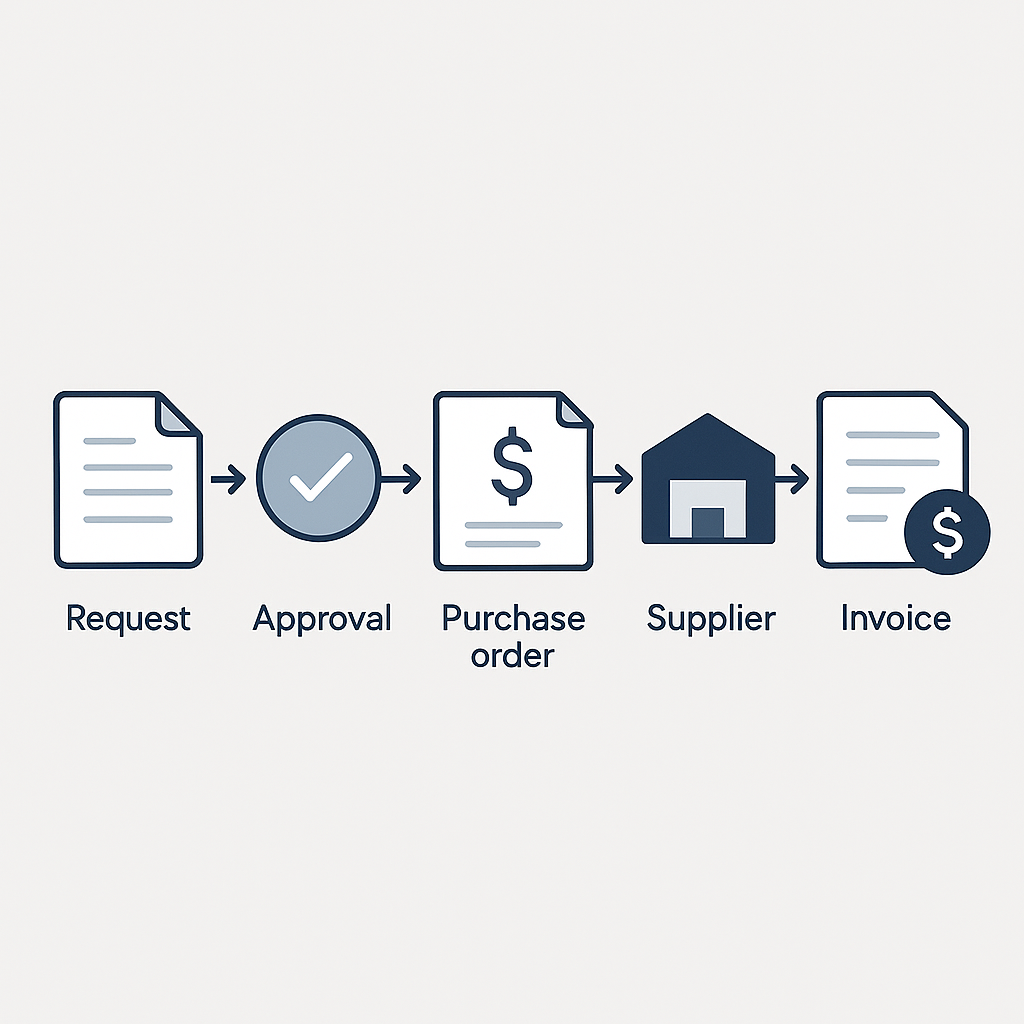
Understanding the Purchase Order Process Flow